Quick Answer: Tree services follow a structured process that includes inspection, trimming, removal when needed, and cleanup. Most homeowners only see the cutting, but the planning and safety decisions behind the work are what help prevent property damage and incomplete results.
What “Tree Services” Actually Means
Tree services involve more than cutting branches or taking down a tree. A complete job includes evaluating the tree, choosing the right approach, carrying out the work safely, and leaving the property in good condition afterward.
This is where confusion often starts. Many homeowners expect a quick job, but rushing the process can lead to missed hazards, unnecessary cutting, or cleanup that feels unfinished. The quality of the result depends heavily on what happens before the first cut is made.
- Inspection and condition review
- Tree trimming or pruning
- Tree removal when needed
- Stump grinding or root-area management
- Debris cleanup and yard restoration
For a closer look at how this process unfolds on-site, see what happens during a professional tree service visit.
When You Might Need Tree Services
Most people don’t start by searching for “tree services.” It usually begins with something that doesn’t look right: a branch hangs lower than it used to, a tree starts leaning, or damage shows up after a storm.
In many cases, the visible issue is the result of a problem that has been developing over time. Trees do not always become hazardous overnight, which is why early attention can make the next step clearer.
Signs a Tree Needs Trimming
- Branches extending over the roof or driveway
- Dead or brittle limbs in the canopy
- Uneven growth that shifts weight to one side
When weight builds unevenly, the tree can become more vulnerable during wind or heavy rain. That imbalance is often where breakage starts.
Signs Removal May Be Necessary
- A lean that has changed or increased over time
- Visible decay or hollow sections in the trunk
- Root damage or soil movement around the base
These point to structural concerns rather than surface issues. A leaning tree, for example, can suggest instability at the base or in the root zone. This is explored further in why trees start leaning and what it means.
Situations That Require Immediate Attention
- Storm-damaged limbs
- Trees close to homes or power lines
- Sudden cracking, splitting, or shifting
Once major structural damage appears, the situation can change quickly. A tree that seemed stable before a storm may not behave the same way afterward.
Step 1: Inspection and Evaluation
Every professional job starts with an on-site evaluation. This step shapes the work that follows.
What Professionals Look For
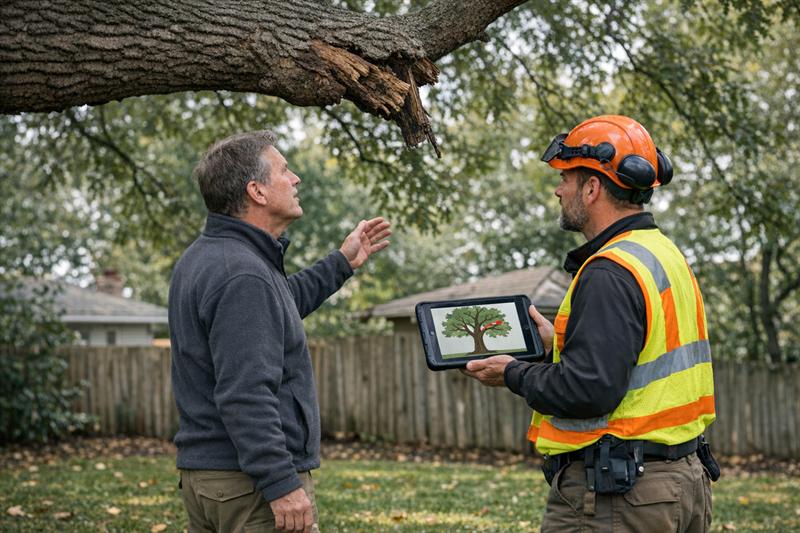
Crews review the tree’s overall condition, structure, and surroundings. That can include signs of decay, weak branch attachments, and the tree’s position relative to nearby roofs, fences, driveways, or other trees.
A tree can look full and healthy from a distance while still having weak areas that affect how it should be trimmed or removed. That is one reason visual appearance alone is not enough to guide the work.
How Risk Is Assessed
Risk is usually based on what the tree or its limbs could impact if something fails. That may include homes, vehicles, fences, utility lines, and neighboring property.
- Fall pattern and branch spread
- Distance to structures and obstacles
- Soil conditions and visible root-area concerns
This is where mistakes can become costly. Removing the wrong section first or misreading how the weight is distributed can create movement that is harder to control once cutting begins.
Step 2: Tree Trimming and Pruning
Trimming is often the right first step, but only when the tree’s overall structure still supports it.
What Trimming Includes
- Removing dead or weakened branches
- Reducing excess weight in the canopy
- Creating safer clearance from structures
Good trimming changes how weight is distributed throughout the canopy. That can reduce stress on certain limbs and lower the chance of branch failure.
When Trimming Is Enough vs. Not Enough
Trimming works best when the issue is limited to branch growth, deadwood, or clearance. It does not correct deeper problems in the trunk or root system.
Sometimes trimming improves the appearance of the tree while the underlying issue continues to develop. If the trunk or roots are compromised, trimming may reduce some immediate exposure without resolving the larger problem.
Step 3: Tree Removal Process
Tree removal is a controlled process done in stages. It is not usually a single cut and a clean fall.
Planning and Safety Setup
Before any cutting begins, the crew prepares the area. Surfaces may be protected, drop zones are identified, and equipment is positioned to help control each section as it comes down.
This planning matters because once cutting starts, the tree’s balance can change quickly. A well-prepared setup helps the crew work with more control from the start.
Cutting and Controlled Removal
The tree is often removed in sections, starting from the upper portions when space is limited. Each piece is cut and guided down in a way that helps limit impact to the surrounding area.
A common misconception is that trees always fall cleanly in one direction. In practice, weight shifts throughout the job, which is why controlled removal is so important.
Handling Trees Near Structures
When trees are close to homes, driveways, fences, or other fixed structures, removal becomes more precise. Sections are lowered carefully instead of simply dropped.
For a detailed breakdown, see what happens during a professional tree removal.
If you’re noticing any of the following, the tree may be beyond routine maintenance:
- The lean appears to be increasing toward your home
- Large branches extend over high-use areas
- Cracks or visible decay show up in the trunk
- Storm damage has already affected the tree
At that point, an on-site evaluation can help determine the safest and most practical next step.
Step 4: Stump Grinding and Root Management
After a tree is removed, the stump remains. Leaving it in place can affect how the area is used and maintained.
What Stump Grinding Involves
The stump is ground below the surface so the area can be leveled and used more easily.
This is the most common approach because it is efficient and usually less disruptive than full extraction.
When Stump Removal Is Recommended
Full stump removal is more likely when the area is being replanted, regraded, or prepared for construction.
Stumps are sometimes left behind with the plan to handle them later, but they can become an obstacle for mowing, landscaping, or future yard projects.
Step 5: Cleanup and Property Protection
Cleanup is part of a complete service, not an afterthought.
Debris Removal
- Branches and logs are removed or cut down for easier handling
- Leaves and smaller debris are cleared from the work area
Yard Restoration
- Raking and leveling disturbed areas
- Restoring usable space where possible
Preventing Damage During the Job
- Protective materials used on lawns and driveways when needed
- Controlled equipment movement through the property
This is often where service quality becomes obvious. Incomplete cleanup can leave behind hazards, damaged turf, or extra work for the homeowner. For more detail, see what proper yard cleanup should include after tree service.
What to Expect During a Tree Service Visit
A professional visit should follow a clear sequence so the homeowner understands what is happening at each stage.
Timeline
The process generally moves from inspection to active work to cleanup. The exact timing depends on the size of the tree, site access, and how close the work is to structures or utilities.
Communication and Updates
At One, Two, Tree, communication is part of the process. Homeowners are kept informed as the job progresses and as any site-specific decisions come up.
Clear communication helps align expectations before work begins and reduces surprises while the job is underway.
How to Choose the Right Tree Service Company
The difference between companies usually shows up in how the work is planned, performed, and finished, not just in the initial quote.
- Clear explanation of the work being recommended
- Defined cleanup and restoration steps
- Thoughtful safety planning
- Consistent communication during the job
Choosing based on price alone can leave important parts of the process unclear. Those gaps may show up later as unfinished cleanup, avoidable property impact, or work that does not fully address the original problem.
A clear plan and strong communication are often better indicators of a complete service.
Conclusion
Tree services involve more than cutting. The biggest problems usually come from skipped evaluation, rushed decisions, or treating the visible symptom without addressing the underlying issue.
When concerns are left unaddressed, they can progress. Leaning trees may continue to shift, weakened limbs can fail under stress, and smaller issues can become more urgent after storms or heavy weather.
At One, Two, Tree, the approach is built around clarity and control at every step. From evaluation to cleanup, the goal is to handle the work thoroughly and leave the property in good condition when the job is done.
If something about your tree doesn’t look right, getting it checked early can make the options clearer and help prevent a more complicated problem later.
Key Takeaways
- Tree services follow a process: inspection, trimming, removal, and cleanup
- Many avoidable problems start with incomplete evaluation
- Trimming helps with maintenance but does not correct deeper structural issues
- Removal is usually done in controlled stages, not with a single cut
- Cleanup and communication are important parts of a complete service
Frequently Asked Questions
What is included in tree services?
Tree services typically include inspection, trimming, removal, stump grinding, and cleanup. The exact scope depends on the condition of the tree and the work needed on the property.
How do I know if my tree needs trimming or removal?
Trimming is generally used for branch-level issues such as dead limbs, overgrowth, or clearance. Removal is more likely when there are larger structural concerns, such as significant lean, decay, or root-related instability. An on-site evaluation helps determine the best approach.
How long does a tree service take?
Many jobs take a few hours to a full day, depending on the size of the tree, site access, and how close the work is to structures. Trees in tighter spaces usually take longer because the removal has to be more controlled.
Do tree services include cleanup?
Cleanup is commonly included, but the scope can vary by company and by job. It often involves removing debris, clearing the work area, and doing basic yard restoration. It is worth confirming the cleanup details before work begins.
What is the difference between stump grinding and stump removal?
Stump grinding reduces the stump below ground level, while stump removal extracts more of the stump and root area. Grinding is faster and more common, while full removal is used when the area needs to be more completely cleared.
Is tree removal dangerous to do without professionals?
Yes, tree removal can be dangerous because it involves heavy material, shifting weight, cutting equipment, and limited margins for error near structures. Professional crews use planning, equipment, and controlled removal methods to manage that risk more effectively.