Quick Answer: A high-risk tree shows visible signs of structural weakness, instability, or decay, especially when it is close to people, vehicles, or buildings. If you notice cracks, leaning, dead limbs, or root problems, it is smart to have the tree looked at before the risk grows.
Why Tree Risk Is Often Misjudged
Tree failure usually develops over time. The warning signs may start small, and from a distance a tree can still look normal even while structural issues are forming.
A common pattern is gradual decline. Small cracks, a slight lean, or a few dead branches may not seem urgent at first, so they get overlooked. Over time, those same issues can become more pronounced and harder to manage.
Normal vs. Dangerous Tree Behavior
Trees go through seasonal changes, but structural problems follow a different pattern. Leaf drop in fall is expected. Large dead limbs, splitting wood, or sections of the canopy thinning out are not.
The difference is persistence. Normal changes are temporary. Structural problems tend to spread or become more visible as the tree weakens.
Why Small Signs Get Ignored
Many homeowners judge a tree by how long it has “been fine.” That can be misleading. A tree may stand for years while gradually weakening, then fail when added stress such as wind or saturated soil exposes the problem.
That is why early signs matter. What looks minor now can become a much bigger issue if conditions change.
The 3 Levels of Tree Risk (A Simple Way to Think About It)
Breaking tree risk into broad levels can make it easier to decide what to do next. On residential properties, most concerns fall into one of these categories.
- Low Risk: Minor imperfections with no clear structural concern and no nearby targets
- Moderate Risk: Early warning signs that could worsen, especially near structures or activity areas
- High Risk: Clear structural issues with a higher chance of failure or damage
For a step-by-step way to evaluate your own trees, use this tree risk checklist for homeowners.
Low Risk (Monitor)
These trees may have small imperfections but appear stable overall. There are no major structural concerns and no immediate targets nearby.
Even so, conditions can change. Periodic checks help catch early shifts before they progress.
Moderate Risk (Plan Action)
This is where many property concerns begin. You might see minor cracks, some dead limbs, or early leaning.
This stage matters because moderate issues are often more manageable when addressed early, but they can worsen if ignored.
High Risk (Urgent Attention)
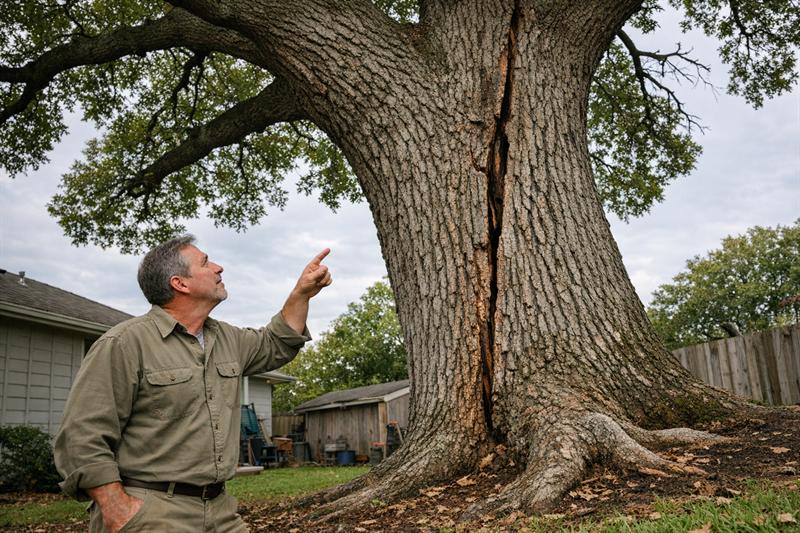
High-risk trees show clear structural concerns such as deep cracks, hollow sections, significant leaning, or unstable roots.
When these conditions exist near a home, driveway, or power line, the potential for damage increases and timing becomes more important.
Visual Signs of a High-Risk Tree
Many high-risk trees show visible changes. The key is understanding what those changes may mean for the tree’s structure and stability.
Structural Damage (Cracks, Splits)
Cracks in the trunk or major branches are one of the clearest indicators of stress. They can mean the tree is no longer distributing weight as well as it should.
In many cases, these cracks deepen over time, especially during wind events or under heavy canopy load.
For a closer look at how these issues develop, review these tree structural weakness signs.
Leaning and Shifting
A long-standing lean that has not changed is different from a recent or worsening lean. Movement at the base or lifting soil can point to instability.
This often traces back to root issues. Once the root system begins to shift, the tree has less support and becomes less predictable.
Dead or Falling Limbs
Large dead branches or repeated limb drop can indicate decline and imbalance in the canopy.
This is often one of the earliest visible warnings. Limb loss can reduce stability and may point to deeper structural problems.
See additional examples of signs of a dangerous tree to compare what you are seeing.
Root Instability
Roots anchor the tree. When they are damaged or disturbed, overall stability can be affected.
This is often seen after construction, grade changes, or soil compaction. Problems below ground may show up later as leaning, sparse growth, or canopy decline. Learn more about root damage signs that can develop quietly.
Internal Decay Indicators
Decay weakens a tree from the inside. A hollow trunk, soft wood, or fungal growth near the base can suggest the structure is compromised.
When internal strength is reduced, the remaining outer shell may not provide enough support during stress.
Location Matters: When Risk Becomes Urgent
Tree condition is only part of the picture. Location plays a major role in how serious the situation is.
A tree with visible issues in an open area may pose less immediate concern than one positioned over a house, driveway, or gathering area.
- Trees over roofs increase the chance of property damage if failure occurs
- Trees near driveways create risk for vehicles and people below
- Trees near power lines add a serious safety concern
Urgency rises when structural issues and nearby targets overlap.
Common Misinterpretations Homeowners Make
Misreading tree condition is one of the main reasons risk goes unaddressed.
- “It’s still green, so it’s healthy” – Leaf growth does not confirm structural strength
- “It hasn’t fallen yet, so it’s safe” – Stability can decline long before failure
- “Only storms cause trees to fall” – Storms often expose weaknesses that are already present
In many cases, the warning signs are visible, but they are easy to underestimate without a closer look.
What to Do If You Spot a High-Risk Tree
Once multiple warning signs appear, the situation usually moves beyond simple observation.
- Monitor minor issues that appear stable
- Track changes if the condition seems to be shifting
- Avoid DIY removal when structural or location risks are involved
- Schedule a professional evaluation when concerns begin to stack up
Delays can make the situation harder to manage. Structural problems generally do not improve on their own.
If you are seeing any of the following, it is time to take a closer look:
- Deep cracks or splitting in the trunk
- Leaning that has changed recently
- Large dead limbs falling
- Roots lifting or soil shifting
At that point, a professional assessment can help clarify what should happen next.
How Professional Tree Risk Assessment Works
A professional tree risk assessment follows a practical process. At One, Two, Tree, the focus is on explaining what is visible, how it affects stability, and what options make sense for the property.
The evaluation typically includes:
- Visual inspection of the trunk, canopy, and overall structure
- Assessment of lean, balance, and weight distribution
- Review of root condition and surrounding soil
- Risk classification based on condition and location
- Clear recommendations for next steps
This approach helps homeowners understand not just the issue, but the reasoning behind the recommendation.
Conclusion
High-risk trees often follow a pattern. Early warning signs appear, get overlooked, and then develop into more serious structural problems.
Left unaddressed, these issues can lead to property damage, safety concerns, and removal situations that are more disruptive than they needed to be.
The most practical step is to act while the situation is still manageable. One, Two, Tree works with homeowners to identify risk clearly and explain what needs to happen next. If a tree is showing signs of instability, damage, or decay, a professional evaluation can help you make a sound decision before the problem becomes more urgent.
Key Takeaways
- High-risk trees show structural weakness, instability, or decay
- Risk increases when trees are close to structures or activity areas
- Early warning signs tend to become more serious over time
- Many tree failures are preceded by visible indicators
- Early evaluation can help reduce the chance of an emergency situation
Frequently Asked Questions
How do you know if a tree is high risk?
A tree is considered high risk when it shows structural damage and is located near something that could be affected. Cracks, leaning, decay, and root instability are common indicators. When several of these appear together, a professional evaluation is a sensible next step.
What makes a tree dangerous near a house?
Proximity increases the potential impact of failure. A tree with structural issues can cause major damage if it is close to a home. Trees over roofs or near driveways deserve closer attention.
Can a healthy-looking tree still be dangerous?
Yes. Trees can have internal decay or root damage while still producing leaves. Structural condition is often a better indicator of risk than outward appearance alone.
Should I remove a leaning tree immediately?
Not always, but a changing or increasing lean is a warning sign. If it is combined with soil movement or root exposure, the tree should be evaluated to better understand its stability.
What is the most common cause of tree failure?
Structural weakness is a common factor. Decay, cracks, and root damage can develop over time, and wind or saturated soil may expose those weaknesses.
When should I call a professional for tree risk?
You should consider calling when multiple warning signs are present or when the tree is near structures, vehicles, or power lines. A professional assessment helps determine the level of concern and the most appropriate next step.