Quick Answer: Tree trimming, pruning, and canopy management all involve branch work, but they can serve different purposes. Trimming usually addresses overgrowth and clearance. Pruning uses selective cuts for specific branch or structural concerns. Canopy management takes a broader view of shape, weight, clearance, and future growth across a tree or property.
If a proposal uses a different term than the one used when requesting service, focus on what the work is meant to accomplish. One, Two, Tree explains the issue being addressed, the areas included in the scope, and what to expect while work is underway.
Quick Answer: Tree Trimming vs. Pruning vs. Canopy Management
Tree trimming is the broad term many people use when branches need to be cut back. Tree pruning refers to selective cutting for a defined purpose. Canopy management takes a wider view of the tree’s crown, including clearance, branch structure, density, weight distribution, and future maintenance needs.
- Tree trimming: Usually focuses on overgrowth, property clearance, and maintaining a controlled appearance.
- Tree pruning: Uses selective cuts to address deadwood, damaged limbs, branch conflicts, clearance, or structural concerns.
- Canopy management: Coordinates work around a tree’s shape, branch weight, density, clearance needs, and long-term growth.
These terms can overlap among tree-service providers. The work objective matters more than the label. A clear recommendation identifies what is being cut, why it needs attention, and what the completed work is intended to address.
What Is Tree Trimming?
Tree Trimming Is Often the Everyday Term for Maintenance
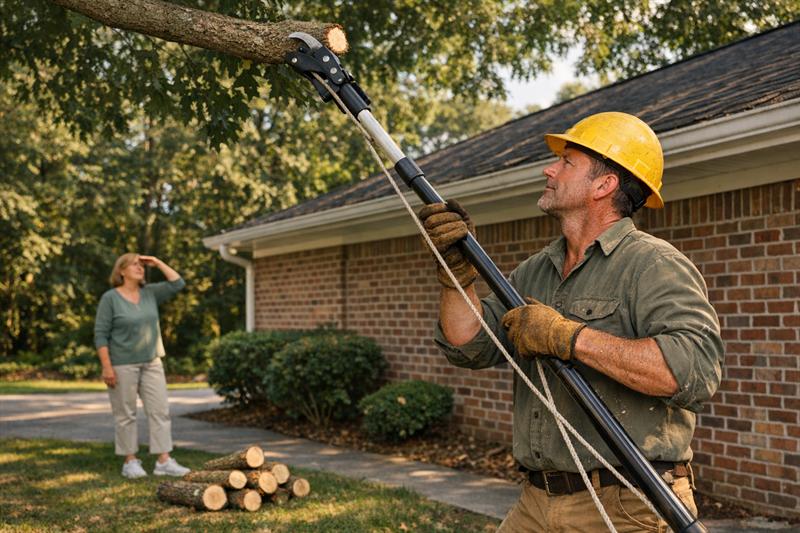
Most property owners use “tree trimming” to describe any service that cuts back branches. In practice, trimming often means reducing overgrowth, restoring clearance around a structure or access area, and keeping branches from interfering with how the property is used.
This type of work may be needed around driveways, rooflines, sidewalks, parking areas, signs, and fences. A branch does not need to be broken to create a problem. When growth begins to close off access or extend into a structure’s space, the scope can become more involved as the canopy continues to expand.
Trimming should not mean cutting branches without a plan. The work still needs to account for the tree’s growth pattern, branch placement, and the specific clearance issue that prompted the call.
Common Reasons a Property May Need Tree Trimming
- Branches over a roof or structure: Continued growth can lead to repeated contact, blocked gutters, and more difficult access for routine maintenance.
- Restricted driveway or walkway clearance: Low or extending limbs can interfere with vehicles, pedestrians, deliveries, and visibility.
- Overgrown parking or entrance areas: Dense growth can affect lighting, signage, traffic flow, and the appearance of an active property.
- Crowded or unbalanced growth: Branches that continue growing into each other can create a canopy that is harder to manage later.
- Routine appearance and access concerns: A tree can look unmanaged long before it becomes an urgent safety concern, but delaying maintenance can mean a larger scope of work.
If branches are crowding structures, blocking access, or hanging lower each season, the maintenance cycle may have been delayed. For more warning signs, review signs your tree needs trimming.
What Should Be Included in a Tree Trimming Scope?
A useful tree trimming proposal does more than say “trim tree.” It should show the property owner what the crew is addressing and how the work relates to the site.
- The trees or specific canopy areas included
- The purpose of the work, such as clearance, overgrowth, deadwood, access, or appearance
- Areas that require coordination, including entrances, parking, traffic flow, landscaping, or tenant access
- Expected site access needs and cleanup expectations
- Conditions that could affect the scope after the tree is viewed more closely
This is where confusion can start. A homeowner may hear “trimming,” while the work also involves removing deadwood, raising clearance over a drive, or addressing branches that rub within the canopy. One, Two, Tree provides clear scope communication and job-status updates so property owners know what is being addressed once work begins.
What Is Tree Pruning?
Pruning Means Making Selective Cuts for a Specific Purpose
Tree pruning is not simply making a tree smaller. It is selective work intended to address a defined issue, such as dead limbs, broken branches, rubbing growth, poor branch placement, or clearance around property features.
A tree left alone for years and then given one heavy cutback may need more than a broad reduction. Removing too much at once can create additional maintenance concerns and may not address the branches causing the actual conflict. Pruning works best when each cut supports a defined objective.
Deadwood removal, branch spacing, canopy clearance, and structural concerns all require a closer look at the tree and its location. More cutting is not necessarily better tree care. The right amount of work addresses the identified issue without treating the entire canopy as a problem.
Common Tree Pruning Objectives
- Removing dead, broken, or damaged limbs: Deadwood can fall. When it is above a driveway, walkway, roof, or occupied area, it may require more prompt attention.
- Addressing crossing or rubbing branches: Repeated contact can create damage points and leave the canopy more crowded over time.
- Improving clearance: Selective pruning can create needed space around buildings, roads, driveways, sidewalks, and parking areas.
- Managing uneven or conflicting branch growth: Branches that extend heavily toward one side of a tree can create clearance and weight-distribution concerns.
- Supporting branch spacing: Targeted work can address crowded branch relationships in a canopy that has developed without maintenance.
- Managing selected density concerns: In some situations, carefully selected interior branch work can improve canopy spacing without indiscriminately stripping it out.
If a tree is dropping branches, leaning toward a target, or showing visible structural concerns, routine pruning is not the only question. The next priority is understanding the tree’s condition and what sits below it.
When Pruning May Not Be the Right Answer
Pruning is not the answer to every tree problem. Severe trunk damage, major splits, root disturbance, extensive decay, or a sudden lean need closer evaluation because those conditions can affect more than the branches being discussed.
Large hanging limbs and storm-damaged branches over occupied areas need direct attention. A visible issue can be more than an ordinary maintenance concern when it affects an active area. For warning signs that deserve closer review, see how to identify a high-risk tree on your property.
Work near energized power lines is also different from routine trimming. Do not cut, pull, climb, or attempt to move branches near utility equipment. Contact the utility provider or a qualified tree-service professional when lines are involved.
What Is Canopy Management?
Canopy Management Is a Broader Tree Maintenance Strategy
The canopy is the network of branches and foliage that forms the upper part of a tree. Canopy management looks beyond one branch or one visit and considers how the tree’s crown affects clearance, branch weight, density, shape, site access, and future maintenance needs.
For one mature tree, canopy management can mean a planned set of selective priorities. For a commercial property, it can mean coordinating work across multiple trees near parking areas, entrances, sidewalks, drive lanes, buildings, signs, and other active spaces.
This becomes important when trees have grown around a property while the property itself has changed. A canopy that once sat well above a driveway or roofline can eventually grow into those spaces. Learn more about tree canopy management and why shape and weight distribution matter.
What Canopy Management May Include
- Crown cleaning: Removing dead, damaged, or broken branches from the canopy.
- Clearance pruning: Creating separation from buildings, drive lanes, signs, walkways, and other property features.
- Structural pruning: Addressing branch placement and competing growth patterns where appropriate.
- Selective thinning: Reducing selected interior branch density when it supports the maintenance goal.
- Targeted reduction: Shortening selected limbs to address a specific clearance, size, or structural concern.
- Ongoing planning: Identifying what needs attention now, what should be monitored, and what can be scheduled later.
These are not interchangeable services. A canopy does not need every type of work simply because it looks dense or overgrown. The right approach depends on the tree, its location, and what the work needs to accomplish.
When Canopy Management Makes Sense for Commercial Properties
Canopy management is especially useful when a property has several mature trees and ongoing access concerns. A one-time trimming request may not solve a recurring issue when branches continue to affect parking, deliveries, lighting, entrances, pedestrian routes, or signage.
- Multiple trees need to be addressed in a coordinated order.
- Work needs to be planned around customer, employee, tenant, or visitor access.
- Drive lanes, parking spaces, entrances, and delivery areas need to remain usable.
- Property managers need a clear record of what is being completed and when.
Clear communication is particularly important on active properties. One, Two, Tree provides detailed scope communication and job-status updates so property stakeholders can follow active work without having to interpret a broad service label after the project starts.
Tree Trimming vs. Pruning vs. Canopy Management: Which Does Your Property Need?
If the Main Issue Is Overgrowth or Clearance
Trimming or targeted pruning is often the practical starting point when branches are growing into roofs, blocking walkways, crowding signs, or reducing vehicle clearance. The first step is to define the clearance goal before work begins.
“Cut it back” is not a complete direction. The better question is: clearance from what, and which branches are creating the problem? That gives the crew a measurable objective and helps avoid unnecessary cutting elsewhere in the canopy.
If the Main Issue Is Dead, Damaged, or Poorly Positioned Branches
Pruning is the more precise term when the concern is deadwood, broken limbs, rubbing branches, or poor branch placement. A dead branch over an unused part of a yard does not create the same urgency as a large damaged limb above a driveway, sidewalk, entrance, or parking area.
If you see broken limbs, hanging branches, repeated branch drop, or visible damage where people and vehicles pass below, arrange an evaluation by a qualified tree-service professional. Leaving the condition in place can increase the chance of further damage or disruption in an active area.
If Several Trees Need a Coordinated Long-Term Plan
Canopy management can be a strong fit when several trees need attention across one property or when the same clearance problems return year after year. Instead of treating each branch as an isolated issue, the plan prioritizes the areas that affect operations first.
This creates a clearer maintenance path: what should be completed now, what should be monitored, and what can be scheduled in phases. That approach helps property owners and managers plan around access, budget, and day-to-day operations.
If There Is an Immediate Safety Concern
Do not treat visible tree damage over active areas as routine trimming. If the tree has developed any of the signs below, arrange an evaluation rather than waiting for the next maintenance visit.
- Large branches hanging over a driveway, walkway, parking area, or entrance
- Significant cracks or splits in major limbs or the trunk
- A tree that has started leaning unexpectedly
- Lifted soil, exposed roots, or root disturbance after weather or construction activity
- Branches touching or close to power lines
- Storm damage restricting property access or threatening a structure
These conditions can worsen if left in place. Keep people and vehicles clear of the area, avoid fallen or energized lines, and arrange an evaluation so the condition can be addressed promptly.
What Tree Trimming, Pruning, and Canopy Management Should Not Be Confused With
Topping or Indiscriminate Cutting Back
Topping is severe, indiscriminate shortening of major limbs or the tree crown. It is not the same as selective pruning or canopy management because it does not focus on the specific branches, structure, or clearance issue that needs to be addressed.
Removing large amounts of canopy without a defined objective can leave a tree with undesirable regrowth and create another maintenance issue later.
Emergency Storm Cleanup
Emergency storm cleanup focuses on immediate conditions: fallen material, blocked access, damaged limbs, and hazards near structures or travel areas. It differs from planned maintenance because the first priority is securing the site and identifying what damage remains.
After immediate hazards are handled, remaining canopy damage may still need review. A tree can appear stable after a branch failure while retaining cracked or hanging limbs higher in the canopy.
Work Near Utility Lines
Branches near utility lines require a separate safety approach. Do not attempt to trim, pull, climb, or remove branches around energized equipment.
Even a branch that appears manageable from the ground can create a serious hazard when electrical infrastructure is involved. Keep clear of the area and contact the appropriate utility provider or qualified tree-service professional.
Questions to Ask Before Approving Tree Work
Before approving trimming, pruning, or canopy management, make sure the recommendation answers these questions:
- What issue is the work meant to solve?
- Which trees and canopy areas are included?
- Is the work focused on clearance, deadwood removal, structure, thinning, reduction, or ongoing canopy management?
- How will the crew access the work area?
- What should employees, tenants, residents, visitors, or customers expect while work is underway?
- What cleanup and debris removal are included?
- Could site conditions change the scope after closer inspection?
- How will work progress and job status be communicated?
A common mistake is comparing estimates only by price when the scopes are not the same. One proposal may cover basic clearance while another includes deadwood removal, cleanup, coordinated access, and a broader canopy plan. The scope shows what problem is actually being addressed.
Key Takeaways
- Tree trimming is the broad term many people use for clearance and overgrowth maintenance.
- Tree pruning uses selective cuts to address specific issues such as deadwood, branch conflicts, structure, and clearance.
- Canopy management takes a wider view of a tree’s shape, branch weight, density, property clearance, and future maintenance needs.
- The right service depends on the condition of the tree, the property layout, and the reason the work is needed.
- A clear scope should explain the work objective, included areas, access needs, cleanup, and communication plan before the job starts.
Conclusion: Choose the Work Objective, Not Just the Service Name
The real problem is not choosing the perfect term. It is approving tree work without a clear understanding of what is being addressed. When overgrowth, deadwood, poor branch placement, or canopy conflicts are handled without a defined objective, the property can be left with the same access issue or a larger maintenance need.
One, Two, Tree helps property owners understand whether trimming, pruning, or canopy management best fits the work at hand. The team provides clear process communication and job-status updates, so you understand what is being addressed, how the work affects the property, and what happens next.
Frequently Asked Questions About Tree Trimming, Pruning, and Canopy Management
Is tree trimming the same as pruning?
Tree trimming and pruning overlap, but they are not always the same. Trimming usually refers broadly to cutting back overgrowth or restoring clearance, while pruning describes selective cuts made for a specific purpose, such as removing deadwood or addressing branch structure.
The useful question is not just what the service is called. Ask what branches are included and whether the goal is clearance, damaged-limb removal, structure, density, or a larger canopy issue. That gives you a clearer basis for approving the scope.
What is canopy management for trees?
Canopy management is a broader plan for managing the shape, density, weight, clearance, and long-term growth of a tree’s crown. It can include crown cleaning, selective pruning, clearance work, targeted reduction, and ongoing maintenance planning.
It is especially useful when a tree affects multiple parts of a property or when several mature trees need coordinated attention. If recurring growth is affecting access, parking, structures, or visibility, request a defined canopy-management scope instead of another vague trimming visit.
Is canopy thinning the same as canopy reduction?
No. Canopy thinning removes selected branches within the crown to address density, while canopy reduction shortens selected limbs to address a specific size, clearance, or structural issue.
They solve different problems and should not be treated as interchangeable. Ask whether the recommendation is intended to reduce density, improve clearance, or address a particular limb before approving the work.
Can a tree be trimmed too much?
Yes. Excessive or poorly planned cutting can leave a tree with an imbalanced canopy and lead to undesirable regrowth. This is why indiscriminate cutbacks may not solve long-term canopy problems.
Tree work should match a defined goal rather than remove as much growth as possible. Before work begins, ask what cuts are planned and what outcome those cuts are intended to achieve.
When should I call a professional tree service?
Call a professional tree service when there are large hanging limbs, visible cracks or splits, sudden leaning, root disturbance, storm damage, branches over occupied areas, or branches near power lines.
These conditions can affect stability, access, and safety below the tree. Keep clear of the area and arrange an evaluation before the condition progresses.
What should a tree trimming or pruning estimate include?
A tree-work estimate should identify the trees or canopy areas involved, the purpose of the work, access considerations, cleanup expectations, and conditions that could affect the final scope.
It should also make clear whether the work is for clearance, deadwood removal, structure, thinning, reduction, or canopy management. One, Two, Tree provides clear communication and job-status updates so the scope remains understandable from planning through completion.