Quick Answer: Common signs of structural weakness in a tree include a recent lean, trunk cracks, root movement, and large dead limbs. These issues can mean the tree is losing its ability to support itself, which raises the chance of failure during high winds or saturated soil conditions.
Many trees that fail are not completely dead beforehand. They are structurally compromised. That difference is where problems start, especially when the warning signs are subtle or easy to misunderstand.
At One, Two, Tree, this comes up regularly during tree inspections. A tree can look full and healthy but still have weaknesses that make it unstable. Recognizing those early signs helps prevent avoidable damage.
What “Structural Weakness” Means in Trees
Structural weakness is about stability, not just overall health. A tree can be alive and growing but still lack the strength to support itself under stress.
This usually shows up in the trunk, major limbs, or root system. When any of these areas are compromised, the tree becomes less reliable, especially during storms or changing soil conditions.
Health vs. Stability: Why They’re Not the Same
Healthy leaves and new growth do not guarantee a stable tree. That is a common misunderstanding.
A tree may look fine from a distance but still have internal decay or weak branch attachments. In those cases, the visible canopy does not reflect the tree’s true condition.
For a broader look at visible warning signs, see common signs a tree is dangerous before it falls.
The Most Common Signs of a Structurally Weak Tree
These are some of the clearest indicators that a tree may be losing structural integrity. One issue matters, but several signs together usually point to a higher level of risk.
- Recent or increasing lean: A slight lean can be natural. A noticeable change, especially with exposed roots or cracking soil, suggests the tree may no longer be anchored the way it should be.
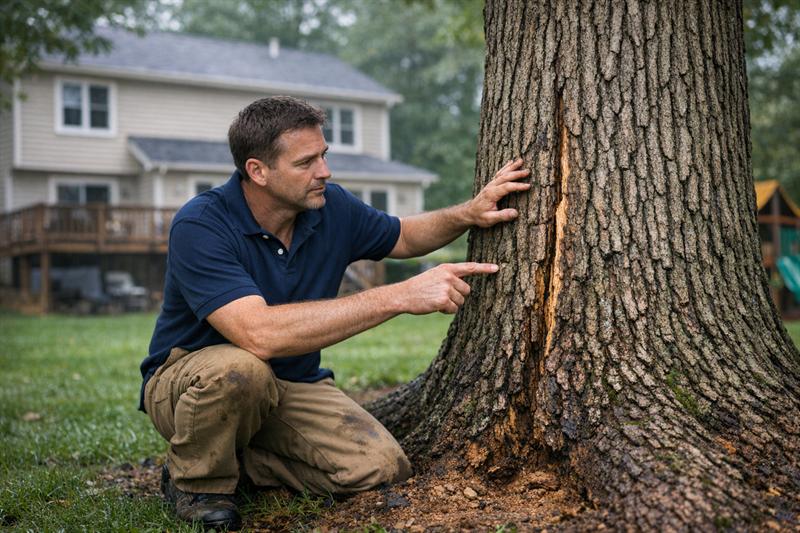
- Cracks in the trunk or major limbs: Deep splits can mean the wood is separating under pressure. This weakens the tree at key support points.
- Co-dominant stems with included bark: When two trunks grow together without a strong connection, that union becomes a common failure point.
- Hollow areas or cavities: Decay inside the tree reduces strength, even if the outer surface still looks solid.
- Root damage or soil movement: Lifting soil or exposed roots can mean the tree’s foundation is shifting.
- Dead or overextended limbs: These create uneven weight distribution and increase stress during wind.
- Fungal growth at the base: This can be associated with decay affecting the lower trunk or roots.
These issues are often overlooked because the signs can seem minor at first. By the time the tree shifts further or drops a limb, the problem is usually more obvious.
If you want a practical way to evaluate what you are seeing, review this tree risk assessment checklist for homeowners.
Why Trees Fail: The Mechanics Behind the Risk
Tree failure usually follows patterns. Once you understand how stress builds in a tree, it becomes easier to recognize which issues matter most.
Load Distribution and Canopy Imbalance
When weight is uneven across the canopy, certain areas take on more stress. This becomes more noticeable when limbs extend too far or one side grows heavier than the other.
Over time, that imbalance can lead to limb failure. As the stress continues, it can also transfer to the trunk and root system.
Internal Decay and Hidden Weakness
Decay can weaken the inside of a tree long before anything shows on the outside. The outer structure may look intact while the interior wood has already lost strength.
Once enough internal support is gone, the tree becomes less able to handle normal loads. That is when failure becomes more likely.
Root System Instability
Roots are what hold the tree in place. When they are damaged, restricted, or sitting in saturated soil, stability drops.
In Atlanta and surrounding areas, clay-heavy soil tends to retain water. After heavy rain, this can soften the ground and reduce how well roots can hold. That is when trees are more likely to lean or shift.
Root space also matters. Limited space can restrict growth and affect long-term stability. Learn more about that in how much space tree roots really need.
When a Tree Becomes a Safety Hazard
Not every structural issue requires immediate removal. The more important question is what the tree could strike and how quickly the condition is changing.
Proximity to Structures
A weakened tree near a home, driveway, or power line creates a much higher level of risk. If it fails, there is little margin for error.
Weather and Soil Conditions in Georgia
Heavy rain, saturated soil, and strong winds increase stress on already weakened trees. This is when many failures happen.
The risk tends to rise during storm season, when the ground softens quickly and wind loads increase.
Compounding Risk Factors
Risk increases when multiple issues show up together. For example:
- Lean combined with root movement
- Cracks combined with heavy canopy weight
- Decay combined with wet soil conditions
When these factors overlap, the tree is under stress from more than one direction.
If you are noticing any of the following, prompt action is usually warranted:
- The tree has recently started leaning or shifting
- Cracks are visible in the trunk or major limbs
- Soil is lifting or roots are exposed
- Large limbs have already fallen or are hanging
These are active warning signs that the tree may be losing stability and should be looked at soon.
What to Do If You Notice These Signs
The right response depends on how far the issue has progressed. Waiting too long is when many situations become more serious.
When Monitoring Is Enough
Small, stable defects that are not changing can sometimes be monitored. This usually applies when there is no visible movement, no progression, and no nearby structures or other likely impact areas.
When to Call a Professional
If several signs are present or something has changed recently, the level of concern has already increased.
This is especially true after storms or extended periods of rain, when hidden weaknesses are more likely to show up.
What a Tree Risk Assessment Involves
A proper assessment looks at the entire structure, not just one issue. The trunk, limbs, and root area all need to be considered together.
That process helps determine whether the safest next step is pruning, support options, monitoring, or removal.
How Professional Tree Services Help Reduce Risk
Once structural weakness is identified, the focus shifts to reducing risk in a controlled way. That may involve removing weight, correcting imbalance, or removing the tree if the structure cannot be relied on.
A common mistake is waiting until something breaks. At that point, the situation is usually more urgent and the options may be more limited.
Understanding what happens during service helps set expectations. See what is included in a professional tree service visit for a clear breakdown.
At One, Two, Tree, the process is explained step by step so homeowners know what is happening and what comes next. That clarity matters when important decisions need to be made quickly.
Key Takeaways
- Structural weakness is about stability, not just appearance
- Multiple warning signs together usually indicate higher risk
- Lean, cracks, and root movement are among the most serious indicators
- Problems often become harder to manage when ignored
- A professional evaluation helps clarify the safest next step
Conclusion
Structurally weak trees rarely fail without warning. In many cases, the signs are there, but they are easy to overlook or underestimate.
When those signs are ignored, the situation can escalate. Limbs break, trees shift, and damage becomes more likely. What could have been handled earlier becomes more urgent and more complicated.
One, Two, Tree focuses on identifying these risks early and helping homeowners understand the next step clearly. Whether the solution is pruning, support options, or removal, the goal is to keep the situation from getting worse.
If you are seeing signs of structural weakness, the next step is to have the tree looked at. Acting early helps keep the situation controlled and reduces the chance of unexpected damage.
Frequently Asked Questions
What are the first signs a tree might fall?
Early warning signs can include a recent lean, trunk cracks, soil movement, and large dead limbs. When several of these appear together, the tree may be becoming unstable.
Can a healthy-looking tree still be dangerous?
Yes. Trees can look healthy while still having internal decay or weak structural points. These hidden issues reduce strength and increase the chance of failure.
How much lean is too much for a tree?
A slight lean can be normal. A recent or increasing lean is usually more concerning because it may indicate root movement or loss of stability.
What causes a tree to suddenly fall?
Common causes include root instability, internal decay, and saturated soil. These weaken the tree’s support system until it can no longer handle its own weight or outside stress.
Should I remove a tree with a cracked trunk?
Deep or expanding cracks can significantly weaken the structure and may worsen under stress. Whether removal is needed depends on the size, location, and severity of the crack.
How do professionals assess tree risk?
They look at the entire tree, including the trunk, limbs, root area, and surrounding conditions. The goal is to identify structural weaknesses, visible stress, and likely failure points so the next step is clear.