
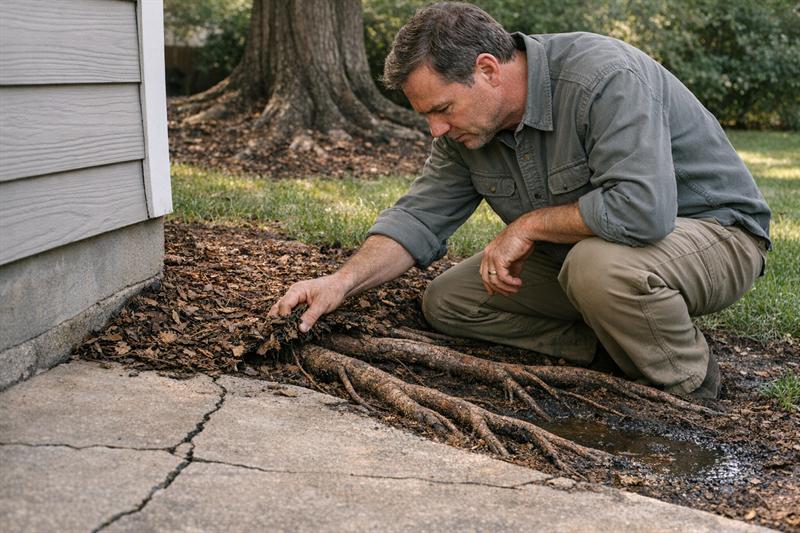
Quick Answer: Tree root spread is usually much wider than people expect, often extending 2–3 times beyond the tree’s canopy. The key reason is that most roots grow outward in search of water and oxygen, not straight down, which can bring them into contact with structures over time.
This is where problems often begin. A tree that looks “far enough away” above ground may already be affecting soil, pipes, or hardscaping below the surface. That gap between what is visible and what is happening underground is why damage sometimes shows up later.
On Atlanta- and Marietta-area properties, it is common for trees that once seemed well placed to keep expanding underground until the effects start showing up in driveways, foundations, or drainage systems.
How Far Do Tree Roots Spread From the Trunk?
Tree roots typically spread at least as far as the canopy and can extend 2–3 times beyond it in some conditions. Most of that growth happens horizontally within the top few feet of soil.
The drip line, or outer edge of the canopy, is often used as a reference point. In real residential settings, roots often extend past that line, especially when they are following moisture or working around compacted soil.
This helps explain why damage can show up farther from the trunk than expected. By the time cracks or shifting appear, the root system has often been in that area for quite a while.
For a closer look at how this affects structures, see how tree roots can damage your foundation.
The Common Rule of Thumb (And Its Limits)
A common guideline is that roots extend to the drip line. That can be a useful starting point in open landscapes, but it does not always hold up in residential yards.
One of the main reasons is uneven growth. Roots shift direction around foundations, driveways, utilities, and compacted soil. Instead of forming a balanced circle, they often spread farther in certain areas.
That uneven expansion can create pressure in the soil and increase the chance of conflicts with nearby structures over time.
Why Roots Grow Wider Than You Expect
Roots grow where conditions support them. That usually means near the surface, where oxygen is available and water is easier to access.
They often move toward:
- Leaky pipes or sewer lines
- Irrigation systems
- Moist soil near foundations
Once roots find a consistent water source, they often continue growing in that direction, which can increase pressure and activity in that area.
Tree Root Spread vs. Tree Size: What Actually Matters
Tree height is not a reliable way to estimate root spread. A taller tree does not necessarily have deeper roots, but it often has a wider reach underground.
Canopy size is a better reference, but it still does not tell the full story. Root systems respond to their environment as much as the tree’s visible size.
That is why two trees of similar size can behave very differently depending on soil conditions, water access, and nearby structures.
Canopy Size vs. Root Zone
The root zone includes the structural and feeder roots that support the tree. It often overlaps with the canopy but can extend beyond it.
In residential settings, roots frequently spread into areas that do not seem connected to the tree at first glance, which is why problems can feel unexpected.
In practice, this means the impact area is often larger than people assume.
Tree Height vs. Root Depth
Most tree roots are located within the top 12–36 inches of soil. Deep roots are less common in residential environments.
This shallow growth pattern is one reason roots can contribute to surface issues like lifted sidewalks and cracked driveways. It also increases the likelihood of interaction with foundations and utilities.
When soil is compacted, this effect becomes more noticeable because roots are more likely to spread outward instead of deeper.
What Affects Tree Root Spread?
Root spread is not fixed. It changes based on the conditions around the tree.
That is where expectations often miss the mark. Roots adapt to what is available, not what was intended when the tree was planted.
Soil Type and Compaction
Loose soil allows roots to spread more evenly. Compacted soil limits depth and pushes roots closer to the surface.
This is especially common in areas where construction activity has compressed the ground. In those conditions, roots are more likely to spread outward in search of workable soil.
More on this can be found in soil quality and tree health.
Water Availability
Roots grow toward water sources. That can include irrigation lines, drainage systems, and small leaks.
When moisture is more available on one side of the tree, root growth can become uneven. Over time, that can concentrate pressure and movement in one area.
In some cases, that is where early signs of damage begin to show.
Tree Species Differences
Some trees develop wider, more aggressive root systems, while others stay more contained.
That is why tree selection matters. Planting a large, fast-growing tree in a tight space can create avoidable problems later.
For better long-term options, see low-maintenance trees that won’t become a problem later.
How Close Is Too Close? Safe Distances From Structures
Tree placement plays a direct role in future risk. The closer a tree is to a structure, the more likely its roots are to interact with it over time.
General spacing guidelines:
- Small trees: 10–15 feet from structures
- Medium trees: 15–25 feet
- Large trees: 20–30+ feet
These distances reflect how roots expand as the tree matures, not just how it looks when planted.
For more context, see how tree placement affects safety and property value.
Foundations
Roots do not usually break solid concrete on their own. More often, the issue is soil movement.
As roots absorb moisture, the soil can shrink, shift, or become uneven. That change can place stress on foundations and contribute to cracks or settling in some situations.
This tends to become more noticeable as the tree and root system grow.
Driveways and Sidewalks
Surface roots can lift concrete and pavers as they expand. This creates uneven areas and visible cracking.
It is often one of the earliest signs that roots have reached a hard surface nearby.
Underground Pipes and Utilities
Roots are drawn to moisture around pipes. Small leaks or weak joints can attract them.
Over time, this can lead to blockages or damage inside the line.
Once roots enter a pipe, the issue usually requires both root removal and repair of the line to keep it from returning.
Signs Your Tree Roots Are Already Causing Problems
- Cracks in driveways or sidewalks
- Uneven or lifting ground surfaces
- Recurring drainage or plumbing issues
- Visible roots spreading across the yard
If these signs are present, the root system may have extended beyond the space originally available to it.
That usually means the issue is active and likely to keep developing if it is not addressed.
Planning Tree Placement the Right Way
The easiest root problems to manage are the ones prevented early. Once roots are established, the options become more limited.
That is why long-term planning matters. The space a tree will need in 10–20 years should guide placement decisions today.
Spacing Guidelines for Residential Yards
Choose trees based on mature size, not current size. This is where many planting decisions go wrong.
A common mistake is planting too close to a house, driveway, or utility line, then facing removal or repairs later when roots start creating conflicts.
When to Avoid Planting Large Trees
Large trees are usually not a good fit for:
- Small residential lots
- Areas close to foundations or utilities
- Tight landscaping layouts
In these situations, root systems often do not have enough room to expand without creating problems.
When Root Spread Becomes a Safety Concern
Root systems can affect more than structures. They can also create safety concerns around the property.
Uneven ground can become a tripping hazard. Soil movement can affect nearby surfaces and retaining areas. In some cases, root loss or imbalance can also affect tree stability during storms.
That is often when corrective work or removal should be considered.
Key Takeaways
- Tree roots often spread wider than the canopy
- Most roots grow near the surface rather than deep underground
- Environmental conditions shape how roots expand
- Poor placement can lead to long-term property issues
- Planning ahead helps reduce the need for costly fixes
Conclusion
Tree root spread is easy to underestimate, and that is where many problems start. What looks like a safe planting distance can lead to issues later as roots expand farther than expected.
These situations rarely stay the same. Root systems continue to grow, and the impact usually becomes more difficult and expensive to manage over time.
One, Two, Tree works with homeowners to identify likely root-related risks, explain what is happening, and recommend practical next steps before the problem gets worse. Clear communication and a step-by-step approach make it easier to understand the options.
If a tree is too close to your home or you are already seeing signs of root impact, the next step is to have the situation looked at before the problem spreads further.
How One, Two, Tree Approaches Root-Related Issues
Every property presents a different set of conditions. Root behavior depends on soil, water, space, tree species, and surrounding structures.
One, Two, Tree focuses on identifying how roots are growing, where conflicts may be developing, and what actions can reduce risk moving forward. Each step is clearly communicated so homeowners understand what is happening and what comes next.
FAQ
How far do tree roots spread compared to the canopy?
Direct answer: Tree roots often extend as far as the canopy and can grow 2–3 times beyond it in some conditions.
Proof or specificity: In residential settings, roots expand outward in search of water and oxygen, which can take them past the drip line.
Next step: If a tree is near your home, it is worth understanding how far those roots may have already spread.
Do tree roots grow deeper than they spread?
Direct answer: No, tree roots typically grow wider rather than deeper.
Proof or specificity: Most roots are concentrated within the top 12–36 inches of soil where oxygen is available.
Next step: Shallow root systems increase the chance of surface issues, so early signs should be looked at.
Can tree roots damage a house foundation?
Direct answer: Yes, tree roots can contribute to foundation issues under certain conditions.
Proof or specificity: This is usually related to soil movement caused by moisture changes rather than roots directly breaking through the foundation.
Next step: If cracks or shifting are visible, it is a good time to have the situation reviewed.
What is a safe distance to plant a tree from a house?
Direct answer: Larger trees generally need 20–30 feet or more from structures.
Proof or specificity: Root systems expand well beyond the trunk, especially in compacted soil or where moisture draws them outward.
Next step: Planning spacing early helps avoid removal or repairs later.
Which trees have the most invasive root systems?
Direct answer: Some species naturally develop wider, more aggressive roots than others.
Proof or specificity: Fast-growing trees and trees planted near steady moisture sources are more likely to interact with nearby structures.
Next step: Choosing the right species for your space reduces long-term risk.
How can you tell if tree roots are causing damage?
Direct answer: Common signs include cracks, uneven surfaces, and drainage issues.
Proof or specificity: These problems can develop as roots expand beneath hard surfaces or around utilities.
Next step: If these signs are present, the issue should be addressed before it becomes harder to manage.