
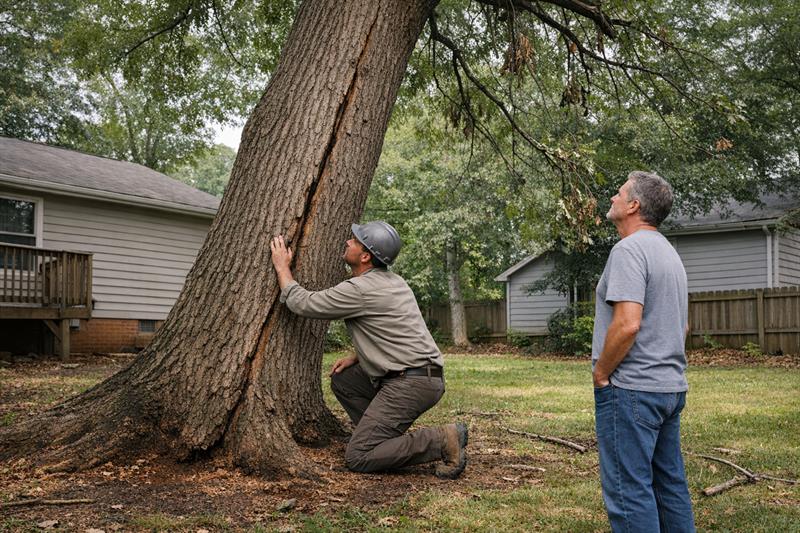
Quick Answer: A tree becomes more dangerous when multiple structural issues show up at the same time, especially in the canopy, trunk, and roots. A clear tree risk assessment checklist helps you spot these warning signs early so you can decide when maintenance, closer monitoring, or professional help is needed.
Why Tree Risk Assessment Matters for Property Safety
Trees can fail because of structural weakness, decay, root problems, or environmental stress. The challenge is that early warning signs are often subtle. A small crack or slight lean may not seem urgent on its own, but it can point to a larger issue that is already developing.
Storms, saturated soil, and nearby construction can make those weaknesses more obvious. A tree that looked stable one week may drop a large limb or shift after heavy weather. In many cases, the earlier signs were present but not looked at together.
When a tree fails, it can damage structures, block access, and create immediate safety concerns. Disease and decay can make this worse by weakening the tree internally before major symptoms are visible. Issues outlined in common tree diseases and how to spot them can also contribute to hidden decline.
Without a clear way to assess risk, small issues are easy to dismiss. Over time, those issues can combine and increase the chance of failure.
When You Should Perform a Tree Risk Assessment
- After storms or heavy winds that stress branches and roots
- When a tree starts leaning, cracking, or dropping large limbs
- During seasonal changes when soil conditions shift
- Before starting landscaping or construction near trees
Many homeowners wait until the damage looks obvious. By then, the tree may already be unstable. Checking early helps catch problems before they become more serious.
If you are noticing visible changes, reviewing common signs a tree is dangerous can help you see whether the issue may be part of a broader pattern.
Complete Tree Risk Assessment Checklist
A reliable assessment follows a sequence. Looking at one part of the tree in isolation does not give a full picture. The canopy, trunk, roots, and surrounding conditions all need to be evaluated together.
Risk tends to build in layers. One issue may not be urgent on its own. Several issues appearing at the same time usually point to a deeper structural problem.
Step 1: Canopy and Branch Condition
- Dead, hanging, or broken branches
- Uneven or thinning canopy
- Cracks where branches connect to the trunk
- Leaf loss outside normal seasonal patterns
The canopy is often where the first visible signs appear. Dead or weakened branches can indicate stress within the tree. When wind or rain adds weight, those branches are more likely to fail.
Step 2: Trunk Integrity and Structural Defects
- Vertical cracks or splitting
- Hollow sections or deep cavities
- Peeling bark or soft, decayed areas
- Fungal growth on the trunk
The trunk supports the load of the entire tree. Cracks, decay, or hollow sections can reduce that strength. Under weather stress or added weight, these weaknesses can lead to breakage.
Step 3: Root System and Ground Stability
- Exposed or damaged roots
- Soil lifting or cracking near the base
- Constantly wet or unstable soil
- Recent construction near the tree
Root problems are easy to miss but often play a major role in tree failure. A tree may look stable above ground while the support system below is compromised.
When roots lose stability, the tree can begin to shift. Over time, that movement raises the chance of leaning or failure. Root systems can also affect nearby structures, as explained in how tree roots can damage your foundation.
Step 4: Tree Lean and Positioning
- A sudden or increasing lean
- Leaning toward a home, driveway, or walkway
- Multiple trunks growing unevenly
- Exposure to strong wind patterns
A slight lean over time can be normal. A sudden change in position is more concerning. When a tree shifts quickly, it often suggests reduced root support or changing ground conditions. That change raises the chance of failure, especially during storms.
Step 5: Environmental and External Risk Factors
- Nearby construction or soil disruption
- Erosion around the base
- Repeated storm exposure
- Nearby trees failing or falling
Tree stability is influenced by its environment. Soil disturbance, water flow, and nearby activity all affect how well a tree stays anchored.
These factors are easy to overlook because problems do not always begin in the tree itself. External conditions can gradually weaken an otherwise established tree.
How to Interpret Your Findings (Low vs High Risk Trees)
Not every issue calls for immediate removal. The key is how those issues combine.
- Lower risk: Minor concerns with no clear structural impact. These can usually be monitored and maintained.
- Moderate risk: Multiple visible issues or a change in condition. This usually warrants a professional inspection to better understand the tree’s stability.
- Higher risk: Structural damage, root movement, or a sudden lean. These conditions usually call for prompt attention.
A single issue may not be urgent. Several issues together increase the chance of failure and should not be ignored.
If you are seeing several of these at once, the situation may have progressed:
- Cracks in the trunk along with dead branches
- Leaning combined with exposed roots
- Soil movement after storms
- Large limbs hanging over structures
At that stage, the tree may be unstable. Waiting can increase the chance of damage, and a professional evaluation is often the next step.
Common Warning Signs That Require Immediate Action
- Sudden leaning with visible root lifting
- Large cracked limbs over roofs or driveways
- Hollow trunk with visible decay
- Tree shifting after storms
These are serious warning signs that can point to advanced structural weakness.
Delaying action in these situations increases the chance of property damage. In some cases, removal becomes the safest option once these signs appear.
When to Call a Professional Tree Service
Visual checks only go so far. When structural condition is uncertain, it becomes difficult to judge risk accurately without hands-on experience.
- Multiple risk factors appearing at once
- Unclear internal decay or damage
- Trees close to structures or power lines
- Any sign of shifting or instability
Professional input is especially important when the next step is unclear. An inspection can help determine whether the tree can be maintained, monitored, or whether removal is the safer path. Acting earlier usually leaves more options available.
How Professional Tree Risk Assessments Go Further
A professional assessment follows a defined process rather than a quick visual scan.
The evaluation moves from canopy condition to trunk structure, then to root stability and surrounding factors. Looking at the whole tree this way gives a clearer picture of how it is holding up.
That broader view helps connect patterns that are easy to miss during a casual check. What seems minor on its own can matter more when combined with other warning signs.
At One, Two, Tree, the process is explained as it happens. Homeowners can see what is being checked, what it may mean, and what options are available next. That clarity helps remove uncertainty and supports faster, more confident decisions.
Conclusion
Tree risk usually develops over time rather than from a single issue. When cracks, lean, root damage, and environmental stress start to overlap, the structure weakens and failure becomes more likely.
If these signs are ignored, the result can be property damage or the loss of a tree that might have been managed earlier. By the time the risk feels obvious, the problem is often more advanced.
A structured checklist makes these risks easier to recognize early and act on before they escalate.
If you are seeing multiple warning signs or are unsure how stable a tree is, One, Two, Tree provides clear, step-by-step assessments that explain what is happening and what should be done next. Taking action early is one of the most practical ways to avoid more serious problems.
Key Takeaways
- Tree risk increases when multiple issues appear together
- Canopy, trunk, roots, and surrounding conditions should all be evaluated
- Root and structural problems are often hidden until they worsen
- Delaying action can increase the likelihood of damage
- A structured checklist helps determine when professional help is needed
FAQ
How do you assess if a tree is dangerous?
A tree is assessed by checking the canopy, trunk, roots, and surrounding conditions together. When multiple issues like cracks, lean, and root damage appear at the same time, the risk is usually higher. A professional inspection can help confirm how serious the situation may be.
What are the biggest warning signs a tree might fall?
Key warning signs include sudden leaning, root lifting, cracked limbs, and hollow trunks. These are commonly associated with structural weakness. When they appear together, the chance of failure is higher and should be addressed quickly.
Can a tree look healthy but still be unsafe?
Yes. Trees can appear healthy while internal decay or root damage weakens their structure. That is why visible condition alone is not always reliable. A full evaluation can help uncover hidden issues.
How often should trees be inspected for safety?
Trees should be checked regularly, especially after major storms or noticeable changes in lean, canopy health, or soil conditions. Many homeowners also schedule a yearly inspection for mature trees or trees near structures.
Should I remove a tree or monitor it?
Minor issues can often be monitored. When multiple structural problems are present, removal may need to be considered. A professional assessment helps determine the safest and most practical approach.
When should I call a professional arborist?
You should call when there are signs of structural damage, leaning, or multiple issues at once. Trees near homes, driveways, or power lines also deserve prompt attention. Acting early helps reduce the chance of more serious outcomes.