Quick Answer: Tree decay can take years to develop, but once structural damage starts, a tree can become dangerous much faster. In many cases, a tree can shift from “looks fine” to a real safety concern within a single season after key warning signs appear.
Introduction
A tree that looked stable last year can start showing small changes that are easy to ignore. A slight lean, peeling bark, or a few dead branches may not seem urgent. The problem is that decay does not progress at a steady pace, and those early signs are often where risk starts to build.
This is where uncertainty sets in. It is not always clear whether to wait, monitor, or take action. Understanding how decay typically progresses makes that decision more straightforward.
The Short Answer: Tree Decay Doesn’t Follow a Fixed Timeline
Tree decay does not follow a predictable schedule. Some trees decline slowly over decades, while others go from minor damage to serious structural weakness in a matter of months. The difference usually comes down to internal condition, not just what is visible on the outside.
On real properties, a tree can appear stable for years, then a storm, root issue, or disease speeds up internal decay. Once that shift happens, the timeline shortens and the risk can increase faster than expected.
Why Some Trees Decline Over Decades
In slower cases, the tree continues to support itself even as internal decay develops. The outer layers remain strong enough to carry weight, which can make the tree seem stable longer than it actually is.
Why Others Become Hazardous in Months
When decay is combined with structural damage, the situation can change quickly. Storm impact, root disruption, or disease weakens key support areas. Once that happens, added stress like wind or saturated soil puts the tree closer to failure.
The 4 Stages of Tree Decay (And What They Mean for Safety)
Even though timing varies, tree decay often follows a recognizable progression. Breaking it into stages helps show where risk begins to build and when action becomes more urgent.
Stage 1: Early Stress (Often Invisible)
This stage begins below the surface. Root damage, soil issues, or early disease affect the tree’s health without obvious warning signs. Problems can start here even when nothing looks wrong yet.
Stage 2: Active Decline (Visible Warning Signs)
Changes become noticeable at this point. Dead branches, thinning leaves, and peeling bark start to appear. A common mistake is assuming the tree still has plenty of time because it is still standing.
Stage 3: Structural Weakening (Higher Risk)
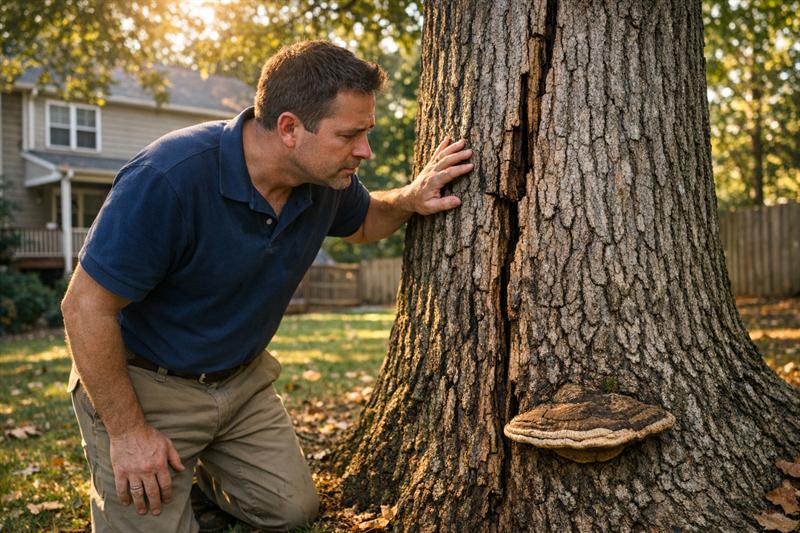
At this stage, the tree is losing strength. Hollow sections, cracks, and fungal growth can point to internal decay. This is where structural integrity starts to break down, even if the tree still looks mostly intact from a distance.
If you are unsure how to recognize these signs, this guide on how to tell if a tree is structurally weak before it fails explains what to look for.
Stage 4: Failure Risk (Urgent Concern)
At this point, the tree may no longer hold its weight reliably. Leaning, splitting, and large dead limbs can signal that failure is getting closer. Weather events like wind or heavy rain can further increase the chance of the tree or a major limb coming down.
What Speeds Up Tree Decay in Georgia
Local conditions play a major role in how fast decay progresses. In Georgia, several factors tend to speed things up.
Humidity and Fungal Growth
Warm, humid conditions support fungal growth, which breaks down wood from the inside. That is one reason decay can move faster in this region.
Storm Damage and Soil Saturation
Heavy rain and wind add stress to already weakened trees. Saturated soil reduces root stability, which is often where leaning and sudden shifts begin. If a tree has recently changed position, it is worth reviewing why trees start leaning and what it means for safety.
Urban Stress Factors
Limited root space, compacted soil, and nearby construction all affect long-term stability. These factors weaken the tree gradually, then problems can accelerate once structural limits are reached.
Signs a Tree May Be Closer to Failure Than It Looks
One of the biggest risks is relying on appearance alone. Internal decay often progresses further than expected before obvious external damage shows up.
- Mushrooms or fungal growth at the base
- Cracks in the trunk or major branches
- Hollow-sounding sections
- Sudden leaning
- Dead or falling branches
- Soil lifting or shifting around the roots
These signs can point to structural issues, not just surface damage. A more detailed breakdown is available in common signs a tree is dangerous before it falls.
How Long Can a Dead Tree Stand Before Falling?
A dead tree can remain standing for years, or it can come down much sooner. The key factor is how much structural strength is left.
Standing does not always mean stable. Once decay reaches load-bearing wood, each storm or strong wind adds pressure. That is why trees that seemed unchanged for years can still fail unexpectedly.
When to Monitor vs When to Remove a Tree
Not every tree needs immediate removal, but waiting too long can make the situation harder to manage. The decision depends on how far decay has progressed.
Situations Where Monitoring May Be Reasonable
Monitoring may make sense in early stages when there is no clear structural damage. Regular observation helps track changes before they become more serious.
When Removal Becomes the Safer Option
Once structural issues are visible, removal is often the safer path. Cracks, leaning, and root instability can point to a loss of support. If the tree is near a home, driveway, or other frequently used area, the margin for waiting is much smaller.
If you are seeing multiple warning signs at once, the situation may be beyond simple monitoring.
- New or increasing lean
- Cracks forming in the trunk
- Large dead limbs overhead
- Fungal growth near the base
At that point, the tree is already in a higher-risk condition. Waiting can lead to a more urgent situation and fewer safe options.
How Professional Tree Assessment Changes the Timeline
A proper assessment looks at structure, not just appearance. Internal decay, root stability, and weight distribution are considered together to better understand the level of risk.
This removes guesswork. Instead of relying on appearance alone, property owners get a clearer picture of the tree’s condition and the practical next steps. One, Two, Tree focuses on straightforward communication and real-time updates, so customers know what is happening and what comes next.
Key Takeaways
- Tree decay does not follow a fixed timeline
- Risk tends to increase in stages, not always gradually
- Visible damage often appears after internal weakening has already started
- Georgia conditions can speed up decay
- Clear warning signs help show when action may be needed
Conclusion
The real issue is not how long decay takes overall. It is how quickly a tree can become unsafe once structural damage begins. That shift often happens faster than most people expect, and delaying action can increase the chance of property damage or a more urgent removal.
If a tree is already showing signs of decay, the next step is to understand its condition before it becomes a larger problem.
One, Two, Tree provides clear assessments, straightforward communication, and real-time updates so there is less uncertainty. When a tree is starting to become a risk, addressing it early is often the most practical way to avoid bigger problems.
Frequently Asked Questions
How long does it take for a tree to rot completely?
It can take several years to decades, depending on the tree and the environment. In humid conditions, decay often progresses faster. If visible decay is already present, structural risk may develop sooner than expected.
Can a tree look healthy but be rotting inside?
Yes. Internal decay often develops before visible signs appear. A tree can look healthy while losing strength internally, which is why problems are sometimes missed until later stages.
What causes a tree to suddenly fall?
Sudden failure is often tied to internal decay, root instability, or storm stress. Once a tree reaches its structural limit, added pressure from wind or rain can cause it to fail.
Is a dead tree always dangerous?
Not immediately, but the risk usually increases as the wood weakens. Over time, the structure breaks down, which raises the chance of failure, especially during storms.
How do you know if a tree is unsafe near your home?
Leaning, cracks, dead limbs, and shifting soil are key warning signs. These can indicate structural weakness, which increases the chance of failure near structures.
Should a decaying tree always be removed?
Not in every case, but once structural damage is present, removal is often the safer option. Early-stage issues can sometimes be monitored, while advanced decay usually calls for action.