Quick Answer: A complex tree removal involves multiple risk factors, such as proximity to structures, tree condition, limited access, and surrounding hazards, that require careful planning and specialized equipment. What looks simple at first can become much more involved once those conditions are evaluated on site.
Many homeowners expect tree removal to be straightforward until they receive a quote or hear that the job is “complex.” The confusion usually comes from factors that are not obvious at a glance. At One, Two, Tree, this comes up regularly. A tree that appears manageable from a distance may involve structural concerns, access challenges, or nearby hazards that change how it needs to be removed.
What “Complex Tree Removal” Actually Means
Complex tree removal means the job goes beyond a simple cut-and-drop approach. It requires planning, controlled removal methods, and careful coordination to reduce risk and protect the surrounding property.
- Size alone does not determine complexity
- Location and surroundings often matter more
- Safety planning plays a central role
Complexity usually increases when multiple factors overlap. A moderately sized tree near a home with limited access can require more planning than a larger tree in an open yard. That is often where problems start when a job is underestimated.
The 7 Factors That Make Tree Removal More Difficult
Most complex removals involve more than one challenge. Understanding these factors helps explain why some jobs take longer and require more coordination.
Tree Size and Weight
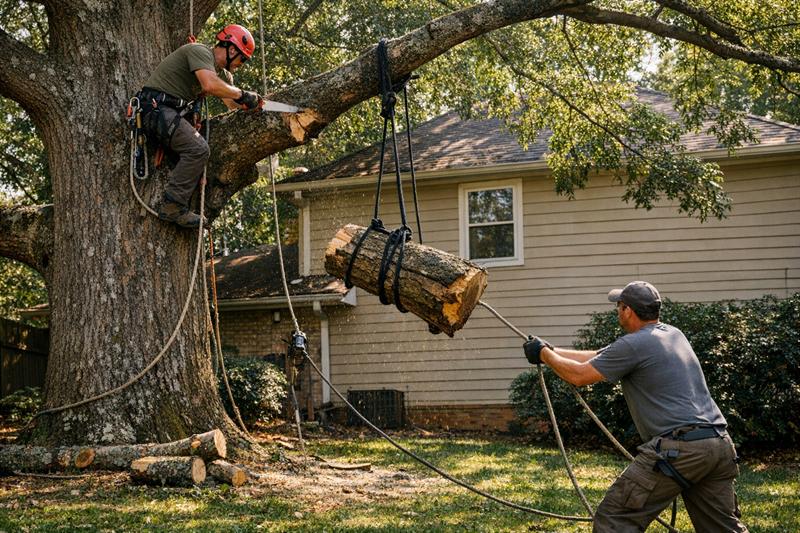
Larger trees carry more weight and typically need to be removed in sections. Each cut has to be planned around balance and load. This increases both the time required and the margin for error if the work is not handled carefully.
Proximity to Structures
Trees near homes, garages, or fences usually cannot be safely dropped in one piece. They are often dismantled in sections using rigging systems to control each movement. Precision matters here, since even small miscalculations can lead to damage. Learn more about how tree placement near structures can create long-term issues.
Limited Access to the Property
Tight spaces, fenced yards, and restricted entry points can limit equipment access. This often requires more manual work, more careful positioning, and a slower removal process. Access limitations can turn an otherwise simple removal into a more technical job.
Tree Condition (Dead, Diseased, or Damaged)
Tree condition plays a major role in complexity. Dead or damaged trees are often less stable and can break unpredictably. Internal decay is not always visible from the ground, which makes careful planning even more important. For early warning signs, see how to tell if a tree is structurally weak.
Surrounding Hazards (Power Lines, Roads, Fences)
Nearby hazards increase both risk and coordination. Trees near power lines, roadways, or shared spaces often require more controlled techniques and careful sequencing. In some situations, additional precautions or coordination may be needed before work begins.
Terrain and Ground Stability
Uneven ground, slopes, or soft soil can affect how crews position themselves and their equipment. This can limit the available approach and require adjustments to the removal plan.
Weather and Timing Conditions
Weather affects how predictable a tree behaves during removal. Wind, wet conditions, or recent storm damage can increase movement and instability. That often leads to slower, more controlled work.
Why Complexity Directly Impacts Cost
Tree removal cost is influenced by time, labor, equipment, and overall job difficulty. As complexity increases, each of these factors typically increases as well.
- More labor hours due to controlled, step-by-step work
- Specialized equipment such as cranes or rigging systems
- Additional safety setup and planning
- More involved cleanup and debris handling
Two trees of similar size can have very different estimates. In many cases, the difference comes from the conditions around the tree rather than the tree itself.
Why Complex Tree Removal Requires Specialized Equipment
More complex removals rely on equipment designed for precision and control. This can include cranes, rigging systems, and bucket trucks.
For example, crane-assisted removal is often used when sections cannot be safely lowered by standard rigging alone. Learn more about crane services for tree removal and when they are used.
Using the wrong equipment can reduce control over how the tree is removed. Problems are more likely to escalate in tight spaces or other high-risk areas.
The Risks of Underestimating a Difficult Tree Removal
When complexity is underestimated, the result can be avoidable property damage, delays, or unnecessary safety risks.
- Damage to roofs, fences, or nearby structures
- Falling limbs creating injury risks
- Improper equipment use leading to unsafe conditions
- Partial removal that leaves remaining hazards
These issues are more likely when decisions are based only on price or when the full scope of the job is not understood. For a deeper comparison, see professional vs. DIY tree removal risks.
If you’re seeing any of the following, the job may be more complex than it appears:
- The tree is close to your home or leaning toward it
- Branches extend over structures or power lines
- The tree shows signs of decay or storm damage
- Access to the area is limited or obstructed
When these conditions are present, a controlled removal plan is often the safer approach.
How Professionals Evaluate a Complex Job (Step-by-Step Insight)
Complex tree removal begins with a structured evaluation.
- Site inspection to understand layout and access
- Identification of risks based on tree condition and surroundings
- Selection of the safest practical removal method
- Planning equipment and crew requirements
- Execution with adjustments as site conditions change
At One, Two, Tree, this process is explained clearly so homeowners understand what is happening and why. For a full breakdown, see what happens during a professional tree removal.
When a Tree Removal Is No Longer Safe to DIY
Some situations go beyond what can usually be handled safely without professional help.
- Trees located near structures or utilities
- Leaning or visibly unstable trees
- Large trees with heavy canopies
- Storm-damaged or partially fallen trees
- Areas with restricted access
If any of these conditions are present, the removal often requires specialized planning and equipment. This is where costly mistakes can happen when the difficulty is underestimated.
Key Takeaways
- Complex tree removal is driven by risk, not just size
- Multiple factors often combine to increase difficulty
- Cost reflects the level of planning, labor, and equipment required
- Underestimating complexity can lead to property damage and added expense
- A professional evaluation helps clarify the safest approach
Conclusion
Tree removal becomes complex when risk factors overlap, especially when those risks are not immediately visible. What appears to be a simple job can involve structural weakness, limited access, or nearby hazards that require controlled, step-by-step removal.
If these factors are not properly evaluated, the result can be property damage, safety concerns, or incomplete work that creates additional problems. That is why the planning stage matters as much as the removal itself.
At One, Two, Tree, complex removals are approached with clear planning, careful execution, and consistent communication so there are fewer surprises during the process. If a tree on your property shows any of the signs outlined above, having it evaluated is a practical next step.
Frequently Asked Questions
What is considered a complex tree removal?
A complex tree removal involves factors like nearby structures, limited access, or poor tree condition. These situations often require controlled, section-by-section removal. A professional evaluation helps identify the safest approach.
Why is tree removal near a house more expensive?
It requires more precise techniques to help avoid damage. Trees are typically dismantled in sections rather than cut all at once. This added control increases time and labor.
Can I remove a large tree myself?
Large tree removal generally involves risks that call for specialized equipment and experience. Tree weight and movement can be difficult to predict. Professional help can reduce those risks.
Does a dead tree make removal easier or harder?
Dead trees are often less stable and more brittle. That can make them harder to control during removal. A site inspection helps determine the safest method.
What equipment is used for complex tree removal?
Equipment such as cranes, rigging systems, and bucket trucks is often used to control how sections are removed. The specific tools depend on the tree, the site, and the surrounding conditions.
How do professionals determine tree removal risk?
Risk is evaluated by looking at the tree’s condition, location, access, and surrounding environment. That information is then used to choose an appropriate removal method and work plan.