
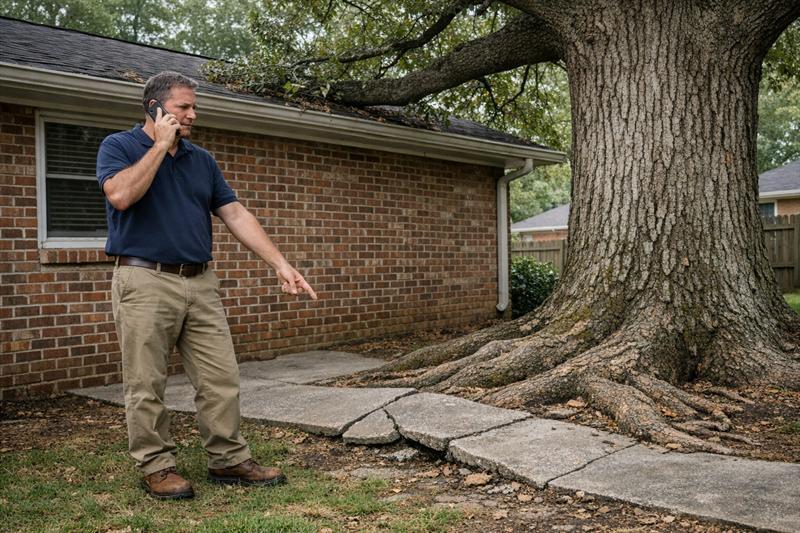
Quick Answer: Tree placement in a small yard usually goes wrong when trees are planted based on how they look today instead of how large they will grow. A better approach is to plan around mature size, nearby structures, and utilities from the start.
Most tree problems do not show up right away. They develop over time as roots spread, branches expand, and space becomes tighter than expected. In smaller yards, those issues tend to show up sooner and are harder to correct without major work.
One, Two, Tree helps homeowners across Marietta and Atlanta with trees that were planted without enough room for long-term growth. A tree that looked well placed at planting can later create clearance issues, ongoing maintenance, or removal decisions that could have been avoided with better planning.
Why Tree Placement Matters More in Small Yards
In a small yard, there is very little margin for error. Once a tree is established, relocating it is rarely practical, and trimming usually manages the symptoms rather than fixing the underlying spacing problem.
A common issue is planting too close to a house or fence because the space looks open at the time. As the tree matures, branches can begin to contact structures, roots can affect nearby surfaces, and maintenance becomes ongoing. In many cases, this leads to heavy pruning or eventual removal.
If you are already seeing signs like leaning, cracking limbs, or uneven growth, it helps to understand how to tell if a tree is structurally weak before it fails. At that point, the issue may involve more than placement alone.
In tight spaces, placement directly affects safety, maintenance, and long-term cost. It is not just a design decision.
The 4 Key Constraints You Must Plan Around
Distance from Your Home and Foundation
Trees planted too close to a home often create problems as they grow. Roots spread outward through the surrounding soil, while branches expand toward the roofline and exterior walls.
This is where problems often begin. What seems like a safe distance early on can turn into roof contact, debris buildup, and recurring clearance work. A deeper explanation is covered in how tree placement near your house impacts safety and property value.
Left unaddressed, this often leads to ongoing trimming or removal once the tree no longer fits the space.
Property Lines and Fences
Planting near property lines can create long-term conflicts. Trees grow beyond boundaries, and overhanging branches often require trimming or lead to disagreements.
One of the most common mistakes is underestimating how far a tree will spread. What starts as a clean layout can turn into crowding along fences and shared spaces. This usually results in ongoing maintenance or pressure to reduce the tree’s size.
Driveways, Patios, and Hardscapes
Tree roots expand into available space, including beneath hard surfaces. Over time, this can contribute to lifting or shifting in driveways, walkways, and patios.
That can create uneven surfaces and added maintenance concerns. Once lifting begins, surface repairs alone rarely solve the problem if the tree remains in place.
Overhead and Underground Utilities
Trees planted under power lines usually require repeated cutting to maintain clearance. This affects how the tree grows and can lead to an uneven or weakened structure over time.
Below ground, roots can also interfere with pipes and utility lines in some situations. For a closer look at how this develops, see how tree roots can damage underground pipes and utilities.
When a tree is placed too close to utilities, the result is often ongoing maintenance or eventual removal if the conflict becomes severe.
Understanding Tree Growth Before You Plant
Root Spread vs Canopy Width
Most placement decisions focus on what is visible above ground. In many cases, the more important factor is what happens below the surface.
Roots often extend beyond the canopy. That means a tree can affect nearby structures and surfaces even when the branches appear contained. This is one of the most overlooked factors in small-yard planning.
Growth Rate and Mature Size
Fast-growing trees are often chosen for quick results, but they can outgrow small spaces faster and may require more maintenance.
A typical scenario is planting for immediate shade, then dealing with overcrowding within a few years. That often leads to repeated pruning or the need to remove the tree earlier than expected.
Common Small-Yard Tree Misconceptions
- “It won’t get that big” — many placement issues start here
- “I can trim it later” — trimming does not stop overall growth
- “Roots grow straight down” — roots usually spread outward and can affect nearby areas
These assumptions often lead directly to spacing problems and long-term conflicts.
A Simple Layout Strategy for Small Yards
Step 1: Measure Your Available Space
Start with accurate measurements. Include width, height clearance, and distance to nearby structures.
This defines what will realistically fit. Skipping this step often leads to overcrowding later.
Step 2: Map Out Fixed Obstacles
Identify immovable elements like your home, driveway, fences, and utilities.
Everything else should be planned around these constraints. This step helps prevent avoidable conflicts.
Step 3: Match Tree Size to Space
Select trees based on mature size, not how they appear when purchased.
This is where many placement problems begin. When the tree eventually exceeds the available space, the solution often becomes heavy pruning or removal.
Step 4: Plan for Shade, Privacy, and Visibility
Think through how the tree will function in the space. Shade and privacy can be beneficial, but blocking visibility near driveways or walkways can create safety concerns.
Good placement balances function with clear sightlines.
Step 5: Leave Margin for Growth
Allow extra space beyond the expected mature size. Trees do not grow perfectly, and even small variations can lead to crowding.
This margin helps prevent future interference with structures and surfaces.
If the layout already feels tight at this stage, the space is likely too limited for that tree.
- Tree placement is close to your home or driveway
- Multiple obstacles limit spacing options
- You are relying on trimming to manage size
- You are unsure of the tree’s mature dimensions
These conditions usually lead to problems that require correction later, often through heavy pruning or removal.
Common Tree Placement Mistakes (and How to Avoid Them)
- Planting too close to the house, leading to roof contact and limited clearance
- Ignoring mature size, which results in overcrowding
- Planting multiple trees too close together, creating crowding and structural issues over time
- Blocking sightlines near driveways, increasing safety risk
- Planting under power lines, leading to repeated cutting and uneven growth
- Assuming pruning will fix spacing issues, which it usually does not
Trees that are not suited for the space often reach a point where removal becomes the most practical option. If you are deciding between trimming and removal, this guide explains when you should remove a tree instead of trimming it.
When to Get Professional Help with Tree Planning
Some yards allow for straightforward placement. Others involve tighter constraints that leave less room for error.
If your space includes nearby structures, utilities, or limited clearance, placement decisions require more precision. This is where professional guidance can help prevent long-term issues.
One, Two, Tree approaches planning with a clear, step-by-step process. Homeowners get straightforward guidance on spacing, expected growth, and potential conflicts before planting begins. This is especially useful when replacing a removed tree or working within a tight layout.
When placement is uncertain, guessing often leads to decisions that are difficult and costly to correct later.
Key Takeaways
- Plan for mature size, not current appearance
- Keep adequate distance from structures and utilities
- Account for both root spread and canopy growth
- Small yards require more precise placement decisions
- Many long-term tree issues begin at planting
Conclusion
Tree placement in a small yard becomes a problem when future growth is not fully considered. What starts as a simple addition to the landscape can turn into interference with structures, ongoing maintenance, or removal.
These problems develop gradually, but once they are visible, the available solutions are often more limited and more expensive.
One, Two, Tree helps homeowners avoid these outcomes by planning tree placement with long-term growth and property impact in mind. If a tree is already outgrowing its space or you are unsure what will work in your yard, clear guidance now can help prevent bigger issues later.
The next step is straightforward: have your space evaluated before planting or before existing problems become more difficult to correct.
How One, Two, Tree Approaches Tree Placement
Tree placement is treated as a long-term property decision that affects safety, maintenance, and usability.
Each project is evaluated based on available space, nearby structures, and how the tree is likely to develop over time. The process focuses on clear communication so there are fewer surprises as the tree matures.
This approach helps reduce the cycle of planting, overgrowth, and removal by improving placement from the beginning.
FAQ
How far should a tree be planted from a house in a small yard?
The distance depends on the tree’s mature size, but larger trees generally need more space from the foundation. Planting too close often leads to clearance and maintenance issues. If space is limited, a professional evaluation can help identify a better placement.
What is the best tree for a small yard with limited space?
Trees with smaller mature sizes and controlled growth habits are usually better suited for tight spaces. Larger or fast-growing trees can outgrow small yards quickly. Choosing carefully at the start helps reduce future maintenance and removal needs.
Can tree roots damage a foundation or driveway?
Roots can spread through surrounding soil and interact with nearby surfaces. Over time, this may contribute to shifting or lifting in some situations. Proper placement is one of the most effective ways to reduce that risk.
Is it okay to plant a tree near a fence or property line?
It can work if the tree’s mature size is taken into account. Trees often grow beyond boundaries, which can create maintenance issues over time. Planning for full spread helps avoid conflicts later.
How do I know how big a tree will get?
Check the expected mature height and canopy spread rather than the size at purchase. Trees are typically much smaller when planted than they will be later. This is one of the most important factors in proper placement.
Can pruning control the size of a tree in a small yard?
Pruning helps manage shape and structure, but it does not stop a tree from reaching its natural size. Relying on pruning to solve spacing issues usually leads to ongoing maintenance. Proper placement reduces the need for corrective work.