Quick Answer: Trees usually fail in storms because of structural weakness or unstable roots, not wind alone. The most effective way to protect trees during storm season is to identify higher-risk trees early, remove dead or weak limbs, and address structural issues before severe weather hits.
Most properties do not have a widespread tree problem. The risk usually comes from a few specific trees showing early warning signs. One unstable tree near your home can create far more risk than several healthy ones.
At One, Two, Tree, that is the pattern we commonly find across Atlanta and Marietta. Storm damage is rarely random. Trees that fail often had visible or structural issues beforehand, but those signals were overlooked or misunderstood.
Why Storms Cause Tree Damage (And What Most Homeowners Miss)
Storm damage is not just about wind speed. It often comes from the combined stress of wind pressure and saturated soil. When both happen at once, trees lose stability.
Trees do not always break cleanly first. They may shift, twist, or begin to uproot. That movement usually starts at weak structural points that were already there.
Wind vs. Weight: The Two Main Failure Points
Wind pushes against the canopy while wet soil weakens root support. When both forces increase at the same time, stability can drop quickly.
Dense canopies catch more wind and transfer that pressure down through the trunk. At the same time, saturated soil reduces how firmly roots hold in place. This combination is where many failures begin.
Why Healthy Trees Still Fall
A tree can look healthy and still fail under pressure. The issue is often internal or below the surface.
Hidden decay, root damage, and poor branch structure are common factors. These problems can develop slowly. By the time a storm arrives, the tree may already be compromised.
If you are unsure what to look for, reviewing common signs a tree is dangerous can help you spot warning signals before they turn into urgent problems.
How to Identify Trees at Risk Before a Storm
Not every tree needs attention. The goal is to identify which ones are more likely to fail.
This is where many homeowners get stuck. Everything looks fine until it does not. In practice, a small number of higher-risk trees account for most storm-related problems on a property.
Signs of Structural Weakness
Look for visible problems in the trunk and branches:
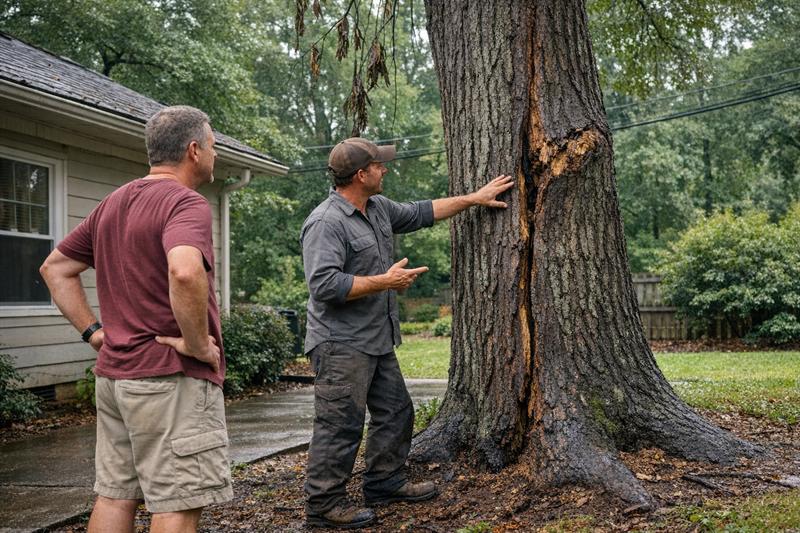
- Cracks or splits in the trunk
- Dead or hanging limbs
- Branches growing unevenly or competing with each other
These are common failure points. When ignored, they are more likely to break under pressure.
Root and Soil Warning Signs
Root instability is one of the most common causes of storm-related tree failure.
- Leaning trees
- Exposed or damaged roots
- Soil that shifts or lifts after heavy rain
This often worsens over time. Each storm can weaken the root system further, making the next event more serious.
Location-Based Risk
Location determines urgency.
- Trees near homes or driveways carry greater consequences if they fail
- Overhanging limbs create direct impact risk
- Trees near power lines require careful handling and planning
If a tree is positioned where it could hit your home, it moves to the top of the priority list.
For a practical way to review your property, this tree risk assessment checklist for homeowners explains what to check and how to prioritize it.
Essential Steps to Protect Trees from Storms
Protection comes down to doing the right work before the storm, not reacting at the last minute.
A common mistake is rushing into trimming right before severe weather. That often targets what looks overgrown instead of what is structurally weak.
Remove Dead or Weak Limbs
Dead limbs are usually the first to fail. Removing them reduces immediate risk and helps limit breakage during high winds.
This is one of the most direct ways to reduce storm-related damage.
Strategic Pruning for Wind Resistance
Pruning should reduce resistance, not create imbalance.
This means thinning dense areas and distributing weight more evenly. Random or aggressive cutting can weaken the structure and shift stress to fewer branches.
Improper pruning can make a tree more vulnerable than leaving it untouched. Learn more about preventing storm damage with proper tree trimming.
Support Systems: When They Help—and When They Don’t
Cabling and bracing can help in specific situations, such as split trunks or heavy limbs with weak attachment points.
They are not general solutions. When used incorrectly, they may not prevent failure and can delay the right next step.
Soil and Root Zone Preparation
Root stability depends on soil conditions.
Mulching helps regulate moisture and protect roots. Compacted soil does the opposite and limits root function. This is a gradual issue that may not become obvious until a storm puts the tree under stress.
If you are seeing any of the following, it is a good time to take action:
- A tree leaning more after recent rain
- Large limbs hanging over your roof or driveway
- Cracks forming in the trunk or major branches
- Soil lifting or shifting at the base
These are common warning signs. In many cases, they warrant a closer look before the next storm.
What Not to Do Before a Storm
Many tree problems get worse because of last-minute decisions.
Over-Pruning Risks
Removing too much canopy changes how wind moves through the tree.
Instead of reducing pressure, it can concentrate stress on fewer branches. That often leads to breakage in areas that were not previously under as much strain.
DIY Mistakes That Increase Tree Failure
Improper cuts and uneven trimming can weaken structure.
Quick, appearance-focused work often ignores balance and branch attachment. The result is a tree that may look cleaner but handle storm stress worse.
When to Call a Professional Tree Service
Some situations go beyond safe homeowner work. That is when professional help becomes the better option.
High-Risk Scenarios That Require Expert Help
- Large dead limbs near structures
- Leaning trees toward your home
- Cracked trunks or visible structural damage
These conditions can worsen under storm pressure and are best addressed early.
What a Professional Assessment Includes
A proper assessment looks at structure, root stability, and surrounding targets such as roofs, driveways, or nearby trees. It also helps clarify what needs prompt attention and what can be monitored.
One, Two, Tree approaches this with clear communication and step-by-step updates so you know what is happening and why. Learn more here: what is included in a professional tree service visit.
Storm Preparation Checklist for Homeowners
- Inspect trees for dead or weak limbs
- Check for leaning or soil movement
- Trim high-risk branches when it can be done safely and correctly
- Clear debris around the base
- Identify trees near structures
- Schedule a professional inspection if needed
Conclusion
Storm damage usually starts before the storm. Structural weaknesses and unstable roots build over time, and severe weather exposes them quickly. When those issues are ignored, the result is often fallen limbs, property damage, and urgent tree work.
The most effective approach is early action. Identify the trees that pose real risk, address structural problems, and avoid last-minute fixes that can make things worse.
One, Two, Tree provides clear evaluations and practical next steps so you know what needs attention and what does not. If a tree on your property is showing warning signs, having it looked at before the next storm can help you avoid a larger problem later.
Key Takeaways
- Most storm damage is tied to a small number of higher-risk trees
- Structural condition matters more than appearance
- Proper pruning can improve how trees handle wind
- Over-pruning and rushed work can increase failure risk
- Professional evaluation helps prioritize what actually needs action
FAQ
How can I protect my trees from strong winds?
Reduce wind resistance and remove dead or weak limbs before storms. Trees with dense canopies and dead branches are more likely to fail under pressure. Focus on early pruning and identifying higher-risk trees.
Should trees be trimmed before a storm?
Yes, but only with targeted pruning. Removing weak limbs can improve stability, while heavy cutting can weaken structure. If significant work is needed, it should be planned rather than rushed.
What makes a tree more likely to fall during a storm?
Structural weakness and root instability are the main factors. Leaning trees, damaged roots, and saturated soil all increase the chance of failure. These signs usually point to the need for closer evaluation.
Can healthy trees still fall in storms?
Yes. Even well-maintained trees can fail when soil becomes unstable or wind pressure is high enough. Location, exposure, and hidden structural issues can all play a role.
Is it safe to prune trees right before severe weather?
It can become risky when pruning is aggressive or done without the tree’s structure in mind. Last-minute cutting often creates imbalance. Any work should be targeted and done correctly.
When should I call a tree service before a storm?
Call when you see structural issues or when a tree is close enough to threaten your home. Large limbs, leaning trees, and visible damage often require professional handling before conditions worsen.