A storm-damaged tree can remain a serious problem after the wind and rain stop. A split trunk, lifted roots, hanging limb, or sudden lean can leave a tree unstable near a home, driveway, vehicle, parking area, or building entrance.
After storms, it is easy to see debris on the ground and assume cleanup comes first. The more urgent question is what remains under tension, what is close to utilities, and what could shift when someone approaches it.
Start With Safety: When Storm-Damaged Trees Become an Emergency
A storm-damaged tree can become an emergency when it threatens people, structures, utilities, or necessary access. The tree does not need to be fully down to create an urgent situation.
Signs a Tree Emergency May Be Present
- A tree or major limb has fallen on a home, vehicle, fence, or occupied structure.
- A tree has developed a sudden lean, split trunk, exposed roots, or lifted soil around its base.
- Large branches are hanging over a driveway, sidewalk, entrance, patio, parking area, or walkway.
- A tree, limb, or debris is touching or near a power line, pole, transformer, or service line.
- A fallen tree blocks a road, fire lane, driveway, loading area, or building entrance.
- People, pets, tenants, neighbors, or customers need to pass through the affected area.
These signs can mean a tree should be treated as unstable until it is assessed. Problems can begin when someone tries to clear a path beneath a hanging limb or cuts branches that appear to be safely on the ground.
Why a Tree Can Still Be Dangerous After the Storm Ends
Wind can crack limbs and trunks without bringing them down right away. Heavy rain can also soften the soil around the root plate, which includes the roots and soil that anchor the tree. When that support shifts, a tree can lean farther or fail later.
Suspended limbs are another common concern. A branch caught in the canopy may look still from the ground, but it may be supported by damaged wood or another weakened branch. Removing it safely can require controlling its movement before it reaches the work area.
For more context, read what trees fall in storms and the risk factors that matter.
Emergency Tree Removal Steps to Take Right Away
The right sequence protects people first and property second. Do not start with a chainsaw, ladder, rope, or vehicle. Start by securing the area and identifying whether the hazard involves power lines, public access, or a tree on private property.
Step 1: Keep People, Pets, and Vehicles Away From the Area
Create a wide boundary around the tree, visible damage, and hanging limbs. Keep children, pets, visitors, tenants, and neighbors out of the area until the hazard is assessed.
Move vehicles only when they can be moved without entering the danger zone. If a vehicle is beneath broken limbs, beside a leaning tree, or close to a damaged utility line, leaving it in place is generally safer than attempting to move it.
Step 2: Stay Away From Downed or Contacted Utility Lines
Assume a downed line or a tree touching a line could be energized. Stay clear of the tree, nearby fencing, standing water, metal objects, equipment, and debris in the area.
Contact the utility provider when a tree or limb involves electrical equipment. Call emergency services when there is an immediate danger to people, a fire risk, or a hazardous obstruction. A line does not need to spark or make noise to be dangerous.
Step 3: Do Not Cut, Climb, Pull, or Reposition the Tree
Do not cut a storm-damaged tree that is leaning, caught in another tree, resting on a structure, or holding suspended limbs. Wind-damaged trees can contain stored tension and compression. Cutting the wrong section can release that force suddenly and shift the remaining tree.
Do not pull the tree with a truck, tractor, winch, or rope. Uncontrolled pulling can move the tree in an unexpected direction, spread damage, and make the hazard harder to manage safely.
Step 4: Contact the Right Emergency Resource
Call emergency services when the tree creates an active threat to people, blocks a public road or emergency route, causes serious structural damage, or involves an injury. Contact the utility provider when lines, poles, transformers, or service connections are involved.
Contact local authorities when a tree blocks a public sidewalk, road, trail, or right-of-way. For a hazardous tree on private property, an emergency tree removal provider can be the next practical resource once immediate public-safety and electrical hazards are addressed.
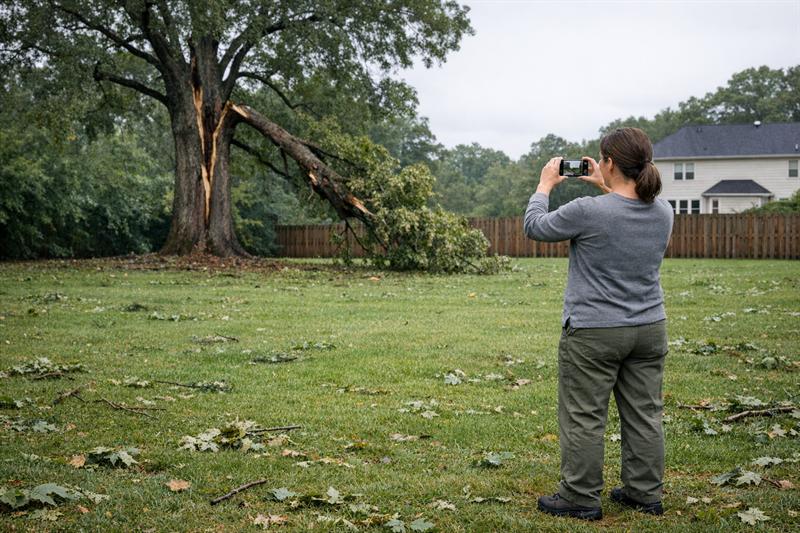
Step 5: Document Damage From a Safe Distance
Take wide photos and videos from outside the hazard area. Capture the tree’s position, affected structures, vehicles, driveway access, parking areas, and visible utility proximity.
Save notes about when the damage occurred and what access is blocked. These details can help an insurer, property manager, utility provider, or tree crew understand the situation without requiring anyone to enter an unsafe area.
Who to Call for a Fallen or Dangerous Tree
The right first call depends on what the tree is affecting. Separating utility, public-safety, and private-property issues can prevent delays and keep the response focused on the most immediate hazard.
When to Contact Emergency Services
Contact emergency services when the tree threatens people, blocks a roadway or emergency route, causes serious structural damage, or creates an active public hazard. A tree across an occupied building entrance, fire lane, or main road can restrict safe movement and emergency access.
When to Contact the Utility Provider
Contact the utility provider when a tree, branch, or debris touches or hangs near an electrical line. The same applies when a pole, transformer, service line, or other utility equipment appears damaged.
Keep the area clear even if the power is out. The absence of lights in a home or building does not mean the line is safe to approach.
When to Contact Local Authorities
Local authorities are generally the right contact when the tree is on public property or blocks a public road, sidewalk, trail, or shared access area. Commercial properties may also need prompt reporting when storm damage affects public-facing parking areas, drive lanes, tenant access, or pedestrian routes.
Municipal responsibilities differ by location and property type. Report the hazard and its location first. Permit questions can usually be addressed after the immediate danger is under control.
When to Contact an Emergency Tree Removal Company
Contact an emergency tree removal company when a tree on private property is unstable, has fallen, threatens a structure, blocks private access, or leaves large limbs suspended over an area people need to use. Once utility crews or public authorities have handled their part of the emergency, the remaining tree work may require controlled removal and debris planning.
The visible fallen section is sometimes only part of the problem. The trunk, root system, remaining canopy, or nearby trees may also need review before the area can be safely reopened.
What to Tell an Emergency Tree Removal Crew
Clear information helps a crew understand the scene before arriving. “A tree is down” is a useful starting point, but details about location, utilities, access, and damage help shape a safer plan.
Details That Help the Crew Understand the Situation
- The property address and the tree’s exact location on the site.
- Whether the tree is on a home, vehicle, fence, driveway, parking lot, entrance, or access route.
- Whether power lines, poles, transformers, or service lines are nearby.
- Whether anyone has been injured or cannot safely enter or leave the property.
- Whether the tree is fully down, leaning, split, uprooted, or holding hanging limbs.
- Whether gates, narrow driveways, parked vehicles, soft ground, or building features affect access.
These details help determine where equipment can be staged, how the work area can be secured, and whether the tree needs to be dismantled in controlled sections. A blocked commercial entrance presents a different work-zone challenge than a tree lying in an open backyard.
How Safe Photos Can Help With Planning
Wide photos taken from a safe distance can show the tree, nearby structures, available access, and utility proximity. They are useful for initial planning, but they do not replace an on-site assessment.
A photo may not reveal a cracked trunk on the far side of the tree, root movement beneath wet soil, or tension in a branch resting against a roofline. That is why the removal plan is confirmed at the property.
What Happens During an Emergency Tree Assessment
An emergency assessment looks beyond the branch or trunk that first caught your attention. The goal is to understand what is holding the tree in place, what could shift next, and how removal can be completed without increasing risk to people, structures, or access routes.
Tree Stability, Failure Points, and Root Damage
The crew evaluates the tree’s lean, break point, trunk condition, remaining canopy weight, and root stability. Exposed roots, lifted soil, or a shifted root plate can show that the tree has lost part of its anchoring support.
After heavy rain and wind, a tree may appear to be standing while the ground around its base points to a stability concern. When roots have moved, the next step is generally a controlled assessment and removal plan rather than waiting to see whether the tree settles back into place.
Structures, Utilities, Access, and Work-Zone Planning
The assessment also considers roofs, windows, fences, vehicles, drainage areas, overhead lines, and the available space for equipment and debris. A tree close to a building is not simply cut down. Its condition and surroundings determine whether work needs to be completed in sections and how those sections can be controlled.
Understanding what happens during a professional tree removal helps explain why access, tree position, and nearby structures affect each stage of the work.
Why the Removal Plan May Change After On-Site Inspection
Storm damage is frequently more extensive than it appears from the street or in a photo. Soft ground, hidden trunk damage, utility coordination, parked vehicles, and limited equipment access can change the work sequence.
One, Two, Tree provides step-by-step communication and job-status updates. When the crew identifies a condition that changes the plan, property owners and site managers can understand what changed, why the sequence changed, and what remains before the area can be used safely.
What Not to Do After Storm Tree Damage
- Do not touch a tree near power lines. Treat the line and the tree as potentially energized.
- Do not stand beneath hanging limbs. Broken branches can fall after the storm has passed.
- Do not cut a tree resting on a roof, vehicle, fence, or another tree. The supported tree can shift when weight is removed.
- Do not pull an unstable tree with a vehicle, rope, winch, or heavy equipment. Uncontrolled pulling can change the tree’s direction without controlling where it lands.
- Do not climb the tree or use a ladder to reach damaged limbs. Damaged wood and unstable footing can turn a cleanup attempt into a fall hazard.
- Do not assume the tree is safe because the wind has stopped. Delayed failure can occur when roots, trunks, or major limbs have been weakened.
- Do not enter a visibly damaged structure until it has been evaluated by an appropriate qualified professional or local authority. A tree impact can affect parts of the building that are not obvious from outside.
Insurance, Permits, and Cleanup After the Immediate Hazard
Insurance, permits, and cleanup matter, but they come after the immediate safety issue. The first objective is to secure the area and address active electrical, structural, or access hazards.
Document Damage Before Cleanup When It Is Safe
Keep photos, videos, dates, written estimates, invoices, and notes about visible damage. Record the condition of structures, vehicles, fencing, hardscapes, landscaping, and access points before cleanup changes the scene.
Insurance coverage and claim requirements vary by policy and insurer. Clear documentation can help separate emergency hazard work from later cleanup, restoration, or landscape decisions.
Emergency Work Versus Follow-Up Tree Work
Emergency work focuses on stabilizing or removing the immediate hazard. Debris hauling, stump grinding, restoration, pruning, and inspection of nearby compromised trees are often follow-up tasks.
For commercial properties, follow-up work can also include reopening access routes, communicating with tenants or customers, and documenting site conditions. The visible tree may be gone while damaged limbs, disturbed soil, or blocked circulation areas still need attention.
These conditions may require prompt attention:
- A tree is leaning farther than it did before the storm.
- Soil is lifting or cracking around the base of a tree.
- Large limbs remain suspended above a driveway, entrance, or parking area.
- A fallen tree has changed access to the property or is resting against a structure.
These conditions may require more than debris cleanup. They can point to a stability issue that needs a controlled assessment and removal plan.
When Local Tree Rules May Apply
Local tree rules can differ based on the city, property type, protected-tree status, tree size, and whether the work involves a public right-of-way. Emergency conditions may be treated differently from planned removals.
Once the urgent hazard is resolved, non-emergency follow-up work should be reviewed against current local requirements. This is particularly important for commercial, multifamily, or public-facing properties where access and site changes affect more than one party.
Reduce Future Storm Tree Risks After Cleanup
Storm damage can reveal weak points on a property. Once the immediate hazard is handled, identify nearby trees that showed similar movement, limb loss, cracks, decay, or root disturbance.
Follow-Up Steps After the Site Is Safe
- Evaluate nearby trees that leaned, lost major limbs, cracked, or showed root movement.
- Address dead, declining, overextended, or structurally compromised branches.
- Review drainage, soil saturation, vehicle activity, and other site conditions that affect root stability.
- Create a clear storm-response communication plan for tenants, employees, visitors, and vendors when managing a commercial property.
Tree maintenance does not guarantee that storms will not cause damage. It can help identify structural concerns before a weather event turns them into an urgent removal problem. Review these storm protection strategies for reducing future tree risk to build a stronger prevention plan.
How One, Two, Tree Supports Emergency Tree Removal Planning
Storm-damaged tree work requires more than clearing what fell first. One, Two, Tree provides commercial tree services for property decision-makers who need to manage hazardous trees while keeping access routes, parking areas, tenants, and public-facing spaces in view.
- Clear step-by-step communication helps stakeholders understand the planned work sequence.
- Job-status updates help site contacts respond when conditions, access, or work zones change.
- A structured assessment helps separate the immediate hazard from the cleanup and follow-up work that comes next.
This approach can be especially useful when a storm affects more than one tree. A damaged entrance, blocked drive lane, unstable nearby tree, and wet ground can turn one event into a broader property-management issue.
Key Takeaways: Emergency Tree Removal Steps After a Storm
- Keep people, pets, and vehicles away from the damaged tree.
- Treat all downed or contacted power lines as dangerous.
- Do not cut, climb, pull, or move a storm-damaged tree.
- Contact emergency services, the utility provider, local authorities, or a tree removal professional based on the hazard.
- Document visible damage from a safe distance.
- Expect a professional assessment to consider tree stability, utilities, structures, access, ground conditions, and debris control.
- Inspect nearby trees after cleanup because storm damage can affect more than the most obvious tree.
Conclusion: Take the Next Safe Step, Not the Fastest Risky One
The real problem after a storm is not simply a tree on the ground. It is the unstable wood, damaged roots, hanging limbs, utility exposure, and blocked access that can remain around it. Trying to clear those conditions without a plan can turn a manageable removal into a larger property and safety problem.
One, Two, Tree is a practical next step for commercial properties facing hazardous storm-damaged trees. Clear the area, address immediate utility or public-safety concerns, and work with One, Two, Tree on a structured assessment, clear communication, and job-status updates that support a workable removal plan.
Frequently Asked Questions
What should I do first if a tree falls after a storm?
First, keep people, pets, and vehicles away from the tree and affected area. Do not cut branches, pull debris, or inspect the trunk closely, because the tree can shift and broken limbs can remain under tension. If power lines, injuries, fire risk, or a blocked public road are involved, emergency services or the utility provider take priority over cleanup.
Is a leaning tree after a storm an emergency?
A sudden lean after a storm can be an emergency when the tree is near a building, driveway, parking area, walkway, or utility line. Lifted roots, soil movement, a split trunk, and major limb loss can show that the tree’s support has changed. A tree does not need to be fully down to require urgent assessment because the risk depends on where it could move and what it could affect.
Can I remove storm-damaged branches myself?
Storm-damaged branches should not be removed by an untrained person when they are hanging overhead, caught in another tree, near power lines, under tension, or resting on a structure. Cutting one branch can release stored force and shift the remaining tree. Small debris already separated on the ground is different, but only when the area is clearly free of utility hazards, overhead limbs, and structural damage.
Who is responsible when a tree falls across a property line?
Responsibility can depend on the tree’s location, the damage involved, local rules, insurance terms, and the condition of the tree before the storm. A tree crossing a property line can create separate cleanup needs on each property, while utility or public-right-of-way damage may involve additional authorities. Safe-distance photos that show the original tree location and affected areas can help document the situation before cleanup changes the scene.
Does property insurance cover emergency tree removal after a storm?
Coverage depends on the policy, the cause of the damage, and whether the tree damaged insured property. The useful distinction is between urgent hazard work and later cleanup or restoration, because those scopes are not always treated the same way. Photos, dates, written estimates, invoices, and notes about structural or access impacts create a clearer record of what happened.
What happens when an emergency tree removal crew arrives?
An emergency crew evaluates the tree’s stability, break point, root movement, hanging limbs, nearby structures, utility hazards, ground conditions, and equipment access. The crew also determines where work can happen safely and whether removal needs to be completed in controlled phases. An on-site assessment matters because a photo can show visible damage but not every force holding the tree in place.