Quick Answer: DIY tree work is best limited to small, low-risk tasks, while most removals and larger trimming jobs are better handled by professionals because of safety concerns, property risk, and the need for controlled cutting. The real decision is whether the job can be managed safely from start to finish.
Why This Decision Matters More Than Most Homeowners Expect
Tree work often looks simple from the ground. A branch seems reachable, and the job feels manageable.
Problems usually start once cutting begins. Weight shifts, branches move unexpectedly, and nearby structures affect how everything falls. What looked straightforward can become difficult to control.
A common example is a homeowner starting a trimming job and ending up with a partially cut limb hanging over a roof or driveway. At that point, the situation is no longer routine and usually requires a controlled approach to finish safely.
The real question is not whether the work can be done. It is whether it can be done safely without creating a bigger problem.
What DIY Tree Work Really Involves
Common Tree Tasks Homeowners Attempt
- Small branch trimming
- Removing dead limbs
- Cutting small trees
- Cleaning up fallen debris
These tasks may be manageable when everything stays within reach and well clear of structures. Once height, weight, or positioning changes, the level of difficulty increases quickly.
Many problems come from incorrect cuts or removing too much at once. Those mistakes can weaken the tree or leave unstable branches behind. For examples, see common tree trimming mistakes homeowners make.
Tools and Equipment Required
- Chainsaws and pole saws
- Ladders and safety gear
- Ropes and wedges
- Debris handling equipment
Having the right tools does not automatically make the job safe or controlled. Many issues happen when tools are used without a clear plan for how the tree or limb will move during the cut.
Hidden Challenges Most People Don’t Anticipate
Tree cutting is about control, not just cutting.
One of the biggest challenges is judging how a branch will react once it is cut. If the weight shifts unexpectedly, the branch can swing, split, or drop in the wrong direction.
This becomes even more difficult when working from a ladder. Balance, tool control, and shifting weight all come into play at the same time.
Cleanup is another part of the job that gets overlooked. What starts as a quick trimming project can turn into a large amount of debris that still needs to be cut down, moved, hauled away, and disposed of properly.
What Professional Tree Services Provide
Step-by-Step Process From Inspection to Cleanup
- Reviewing the tree and the surrounding area
- Planning cuts based on the tree’s structure and nearby obstacles
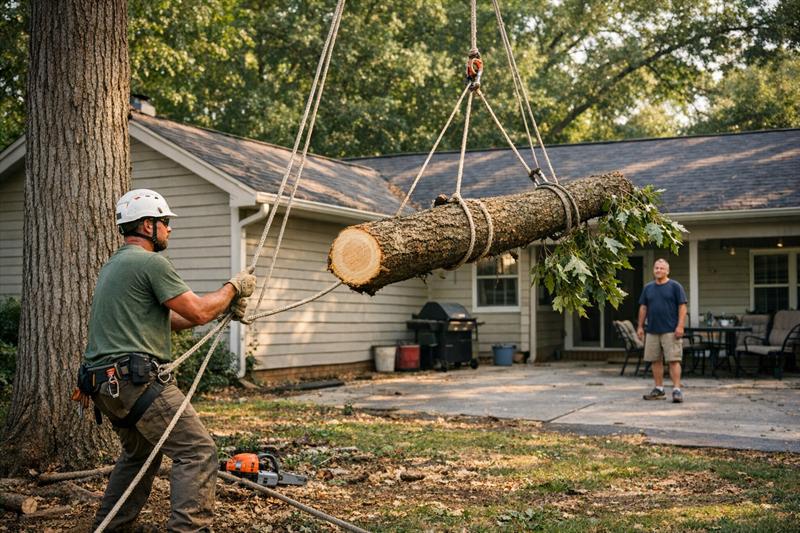
- Using sectional removal when needed to keep each cut controlled
- Using rigging to help guide and lower branches
- Completing cleanup and debris removal
The difference here is planning and control. Each step is meant to manage how the tree moves rather than reacting after something goes wrong.
For a closer look at how this process is handled, see what is included in a professional tree service visit.
Safety Systems and Equipment
- Harnesses and climbing systems
- Rigging ropes and pulleys
- Professional-grade cutting equipment
- Coordinated team execution
These systems help control movement at each stage of the job. That level of control is difficult to achieve with basic tools alone.
Insurance and Liability Protection
Tree work can put surrounding property at risk. If something goes wrong, damage can happen quickly.
Without appropriate coverage, repair costs may fall on the homeowner. That can include roofs, fences, vehicles, or neighboring property, depending on the situation.
Professional tree companies often carry insurance, which can help reduce the homeowner’s exposure if there is accidental damage.
Key Differences: DIY vs Professional Tree Service
Safety Risk Comparison
- DIY: Less control over falling direction and a higher chance of injury or property damage
- Professional: Planned cuts and equipment designed to help guide movement
The biggest difference is control. Once control is lost, outcomes become much harder to predict.
Cost Comparison (Short-Term vs Long-Term)
DIY may reduce the upfront cost, but it does not remove the risk.
If something goes wrong, the cost can shift to repairs, extra cleanup, replacement work, or hiring a professional to finish a job that became unsafe to continue.
Time and Complexity
Tree work rarely stays as simple as it first appears. Cutting, repositioning, and cleanup all take time.
The job becomes more complicated when hidden issues show up, such as decay, weak attachment points, or unstable limbs.
Quality and Outcome
Incorrect cuts can affect how a tree grows and how stable it remains. Over time, that can lead to weak structure or additional maintenance issues.
In some cases, poor trimming creates new problems instead of solving the original one.
When DIY Tree Work May Be Reasonable
- Small branches that can be reached safely from the ground
- No nearby structures, vehicles, or other obstacles
- Healthy, stable trees
- Proper tools and a clear understanding of the task
These situations are generally more predictable and easier to manage. Once height or location becomes a factor, the risk increases quickly.
When Hiring a Professional Is the Safer Choice
- Trees near homes, driveways, fences, or power lines
- Larger trees with significant height or spread
- Storm-damaged or leaning trees
- Branches positioned over structures
- Situations that need prompt removal to prevent further damage
These conditions reduce control and increase risk. Trees that appear stable can still have hidden structural issues. Learn more about common signs a tree is dangerous before it falls.
If you are seeing any of the following, the job has likely moved beyond basic DIY work:
- Branches hanging over your roof or driveway
- A tree leaning after a storm
- Cracks or hollow sections in the trunk
- Large limbs that require a ladder to reach
At that point, controlled removal or an on-site review from a tree service is usually the smarter next step.
How to Decide Based on Your Specific Situation
The decision becomes clearer when a few factors are considered together.
- Tree size: Larger trees require more planning and control
- Location: Trees near structures increase the potential for damage
- Condition: Damaged or leaning trees are less predictable
- Urgency: Storm-related issues often need a quicker response
If more than one of these factors is present, professional handling is usually the safer option.
What to Expect From a Professional Tree Service Company
A professional service should feel organized, not uncertain. The plan should be explained before work begins and communicated clearly throughout the job.
- Clear explanation of the approach before cutting starts
- Updates as the work progresses
- A defined timeline for completion
- Full cleanup when the job is finished
At One, Two, Tree, that level of communication is part of the process. Each step is explained so the homeowner understands what is happening and what comes next.
Conclusion
The real issue is not whether tree work can be done yourself. It is whether it can be done without losing control of the outcome.
When tree work is handled poorly, it can lead to property damage, incomplete removal, or a situation that becomes harder to finish safely. Problems like that usually become more expensive to fix.
One, Two, Tree is built around preventing those situations. Every job follows a clear plan, with step-by-step communication and updates throughout the work.
If a tree is large, damaged, or close to your home, the next step is to have it looked at and handled properly before the situation gets worse.
Key Takeaways
- DIY tree work is best for small, low-risk situations
- Most tree removals require planning and controlled execution
- Risk increases with height and proximity to structures
- Incorrect work can lead to added cost and ongoing issues
- Professional services focus on control, safety, and complete cleanup
FAQs
Is it cheaper to remove a tree yourself or hire a professional?
DIY usually costs less upfront, but expenses can rise quickly if damage occurs or the job cannot be completed properly. Looking at the full risk and total cost gives a more accurate comparison.
How dangerous is DIY tree removal?
DIY tree removal becomes much riskier when height, weight, and fall direction are involved. Without a controlled approach, branches can move unpredictably. Larger or unstable trees are usually better handled by a professional tree service.
What size tree can I safely cut down myself?
Small trees that can be cut safely from the ground are generally more manageable. Once ladders, climbing, or complex fall control are involved, the risk increases. Larger trees usually require a more controlled approach.
Do I need insurance to remove a tree on my property?
Damage that happens during DIY tree work may become the homeowner’s responsibility, depending on the circumstances and the insurance coverage in place. Professional tree companies often carry insurance that can help reduce that exposure.
When should I call a professional tree service?
When a tree is large, damaged, leaning, or close to structures. Those conditions make the work less predictable and harder to control. A professional can review the situation and recommend the safest way to handle it.
What equipment is required for tree removal?
Tree removal can involve saws, safety gear, ropes, and controlled cutting methods. Larger jobs may also require rigging systems and coordinated handling. When that level of equipment and planning is needed, professional service is usually the better choice.