
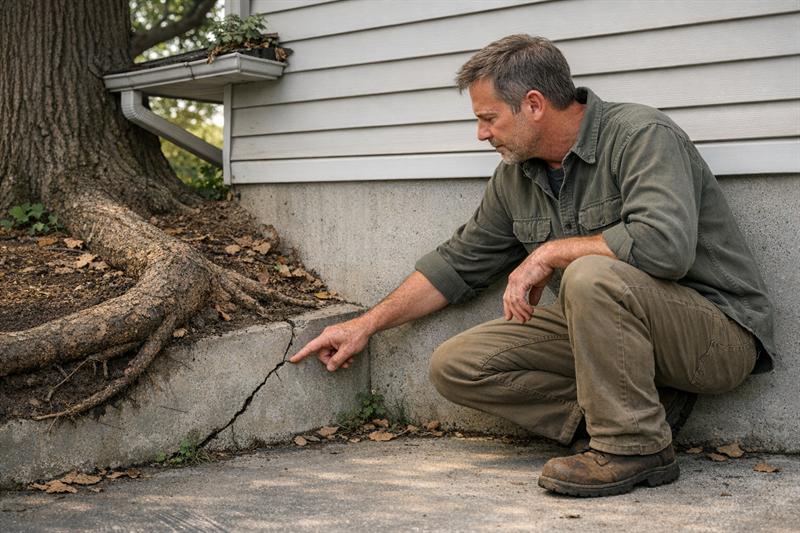
Quick Answer: Tree growth near a house can become a problem over time because roots expand underground while the canopy grows above. As a tree matures, it can affect soil movement, hardscapes, drainage, and areas around the home if that growth is not managed early.
Why Trees That Seem Safe Today Can Become a Problem Later
A tree can look stable for years and still contribute to gradual structural stress. One reason is that much of the early impact happens underground, where changes are easy to miss.
Homeowners often notice a crack, uneven surface, or drainage issue only after it becomes visible. In many cases, the tree has been influencing nearby soil conditions for quite a while before the problem is obvious.
Trees grow in stages. Early growth rarely causes noticeable issues, but as roots expand and the canopy spreads, the likelihood of interaction with nearby structures increases. Left unaddressed, that slow progression can turn into damage that feels sudden even though it developed over time.
Planning distance early makes a significant difference. For example, how to plan tree placement for small yards explains how early placement decisions shape long-term outcomes.
How Tree Roots Expand and Interact With Structures
Early-Stage Root Growth (First 5–10 Years)
In the early stage, roots spread outward in search of water and nutrients. At this point, they usually create little direct pressure on nearby structures.
The important detail is direction. Roots tend to follow moisture and favorable soil conditions. If consistent moisture exists near a foundation, irrigation line, or pipe, roots may grow toward that area.
That early growth pattern often influences how the tree will interact with your property later on.
Mid-Growth Pressure on Soil and Hardscapes
As a tree matures, roots thicken and begin to affect the surrounding soil more noticeably. This is often when surface-level changes start to appear.
Common signs include minor lifting in sidewalks, small driveway cracks, or subtle shifts in nearby surfaces. At this stage, roots are no longer just spreading outward. They are starting to change how pressure moves through the soil.
This can become more noticeable when soil conditions are already stressed. Compacted or uneven soil may increase how that pressure affects nearby structures. More detail on this is covered in how soil compaction affects tree roots, growth, and stability.
Mature Root Systems and Structural Risk
At full maturity, root systems often extend well beyond the canopy. This is when interaction with nearby structures can become more significant.
Roots may influence soil around foundations, grow into areas with underground utilities, and contribute to instability when soil stays overly wet. These effects usually build gradually rather than appearing all at once.
If drainage issues or recurring plumbing problems are showing up, mature roots may be part of the situation. By that point, the process has often been developing for years.
Above-Ground Growth: Branches, Canopy, and Roof Impact
Canopy Spread and Shading Effects
As the canopy expands, it changes how sunlight and moisture affect your home. Increased shade can slow drying on parts of the roof and around the structure.
Over time, that added moisture exposure can contribute to wear. It can also create uneven moisture conditions in the soil around the home, which may affect how the ground settles or shifts.
Branches Overhanging Roofs and Gutters
Branches that extend over a home can lead to repeated contact and debris buildup. Leaves and small limbs may clog gutters and hold moisture against roofing materials.
They can also make it easier for pests to reach the structure.
By the time visible buildup or wear is obvious, the tree has often been affecting the area for some time.
Storm Vulnerability as Trees Mature
Larger trees carry more weight and have broader canopies, which increases wind resistance.
A common pattern is that heavier limbs become more vulnerable during storms. When failure happens, it is usually sudden rather than gradual.
Balanced canopy structure can help reduce that risk. This is explained further in tree canopy management and weight distribution.
Common Signs Tree Growth Is Affecting Your Property
- Cracks forming in the foundation or interior walls
- Driveways or sidewalks becoming uneven
- Recurring drainage or plumbing issues
- Soil lifting or visible roots near structures
- A tree beginning to lean or shift position
If one of these signs is present, the tree may already be affecting the property. When several appear together, the issue is often more advanced.
At that point, monitoring alone is not always enough.
If you’re seeing any of the following, it’s time to take a closer look:
- New or widening foundation cracks
- Roots visible close to the home’s base
- Branches making contact with the roof
- Noticeable changes in tree position or lean
These are active signs that the tree may be affecting nearby structures or stability. Delays can make the repair or mitigation work more involved later.
How Distance and Tree Species Influence Risk
Risk varies widely depending on the type of tree and where it is planted. Some species grow quickly and develop expansive root systems, while others stay more compact.
A common mistake is judging safety based on the tree’s current size. What matters more is its mature size and typical growth habit.
Roots often extend beyond the visible canopy, which means distance can be misleading if the tree was not planned with long-term growth in mind.
This is where proper selection and placement matter. Trees planted without considering mature size are more likely to create long-term issues.
When Tree Growth Becomes a Safety Concern
Tree growth becomes a safety concern when changes move beyond appearance and start affecting stability or nearby structures.
Cracks that continue to expand, shifting surfaces, or noticeable changes in tree position are all signs that conditions may be changing.
These issues can become more apparent after heavy rain, when saturated soil allows more movement around roots.
If a tree begins to lean or the surrounding ground lifts, it may point to a stability issue that needs closer evaluation rather than routine maintenance.
What Homeowners Can Do to Manage Tree Growth Safely
Monitoring vs. Intervention
Monitoring makes sense when no structural changes are present. Once visible impact appears, a more active approach is often needed.
Waiting too long is a common reason small, manageable issues turn into larger ones that require more extensive work.
Pruning and Root Management
Pruning can reduce canopy weight and limit contact with structures. In some situations, root management may help reduce future conflicts.
These approaches are usually most effective when used early. Once structural impact is visible, their ability to limit further problems may be more limited.
When Removal Is the Safer Option
In some situations, removal becomes the most practical way to prevent further impact, especially when structural issues or instability are already present.
That said, not every situation requires removal. Many trees can still be managed safely depending on their condition. A more detailed breakdown is available in when tree removal is not the right solution.
When roots are already affecting areas near a foundation or the tree shows signs of instability, removal is often the step that stops the issue from progressing.
Key Takeaways
- Tree-related problems usually develop gradually, often before visible signs appear
- Both roots and canopy growth can affect nearby structures
- Early signs may be subtle but are worth addressing
- Tree type and placement play a major role in long-term risk
- Delaying action often increases complexity and cost
Conclusion
Problems from tree growth near a house rarely begin when damage becomes visible. They usually build over time as roots expand and the canopy grows closer to the structure.
When that progression is ignored, it can lead to ongoing stress on surrounding surfaces, drainage systems, and parts of the home. By the time the issue is obvious, the solution is often more involved.
At One, Two, Tree, the focus is on understanding what is happening, how far it has progressed, and what next step makes sense based on the tree and the site conditions.
If you’re seeing signs of impact or want a clearer picture of the risk before it gets worse, a professional evaluation can help you decide what to do next.
FAQ
Can tree roots really damage a house foundation?
Tree roots can contribute to foundation-related problems over time by affecting soil movement and interacting with existing weak points. If cracks are visible, a closer evaluation can help determine whether the tree is part of the issue.
How close is too close for a tree to be near a house?
It depends on the tree’s mature size and typical root spread. Larger trees usually need more distance because their roots can extend well beyond the canopy. Trees planted too close are more likely to affect nearby structures as they grow.
What are the first signs of tree root damage?
Early signs often include small cracks, uneven surfaces, and recurring drainage issues. These usually develop gradually. When several signs appear together, the situation may be more advanced.
Should I remove a tree that’s close to my home?
Not always. Some trees can be managed with pruning, monitoring, or other preventive work. If structural impact or instability is present, removal may be the most effective way to reduce further risk.
Do all trees cause structural damage over time?
No. Risk depends on species, placement, soil conditions, and maintenance. Trees that are properly placed and maintained are less likely to create problems for nearby structures.
How do you stop tree roots from damaging property?
Early planning, root management, and pruning can help reduce risk. Once roots are already affecting nearby structures, those options may be more limited, and a professional evaluation can help identify the next step.