Introduction
It usually starts with something small. A tree looks slightly more tilted than it did before. A large branch drops without warning. A crack shows up where there wasn’t one last season.
The challenge is knowing what it means. Some changes are normal. Others point to a real safety issue. Waiting too long can increase the risk, but reacting without enough information can lead to unnecessary work.
Understanding the signs of a dangerous tree helps you decide what needs attention now and what may simply need monitoring.
Why Some Trees Become Dangerous Without Obvious Warning
Not every hazardous tree looks damaged on the surface. In some cases, the structure weakens internally while the outside still appears stable.
Environmental conditions also play a role. In the Atlanta and Marietta area, repeated rainfall and shifting soil can gradually reduce stability, even when a tree still looks healthy.
Hidden Structural Weaknesses
Internal decay is a common reason trees become unsafe. Hollow sections or rotting wood can reduce a tree’s ability to support its own weight. From the outside, the trunk may look solid, but the strength is no longer there.
A tree can still have a full canopy while the trunk is compromised. By the time visible cracks appear, the internal damage may already be advanced.
Environmental Stress Factors
Soil conditions have a direct impact on stability. Saturated ground can loosen root systems, especially after extended rain. This ties closely to what’s explained in The Importance of Soil Quality for Tree Health, where root support depends heavily on the surrounding soil.
Storm damage can also add up over time. A tree may hold up through one storm, but repeated stress can weaken key structural points and increase the chance of failure later.
The Most Common Signs a Tree May Be Dangerous
Some warning signs are minor on their own. When several show up together, the overall risk increases and may point to a deeper structural issue.
- Sudden leaning or shifting position
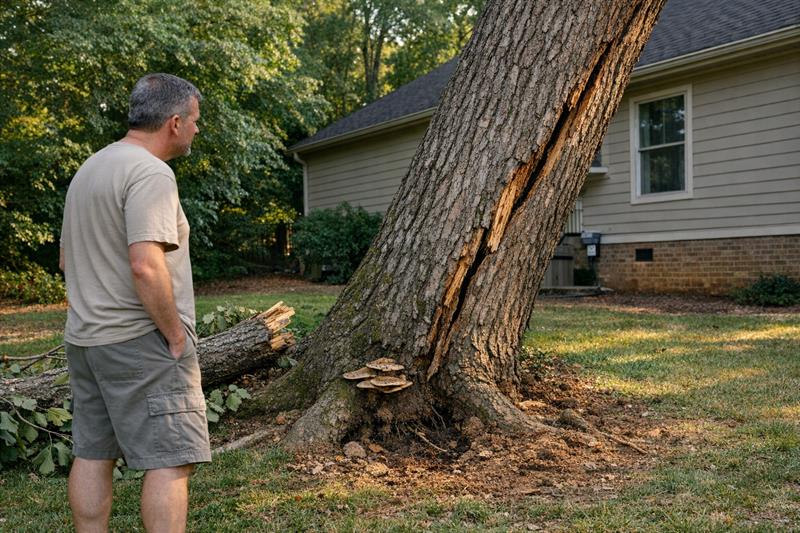
- Cracks or splits in the trunk
- Large dead or falling branches
- Hollow or decaying wood
- Root damage or lifting soil
- Fungal growth at the base
- Thinning or uneven canopy
Sudden or Increasing Lean
A slight lean can be natural, especially if it developed gradually. A new lean or one that is getting worse is different. This can point to root movement or loss of support in the soil.
Cracks or Splits in the Trunk
Cracks are a sign the tree is under stress. Deeper splits can weaken the structure and affect how weight is distributed. These are more than surface-level issues and deserve attention.
Dead or Falling Branches
Small branch drop happens naturally. Large limbs falling without a clear cause are more concerning. In many cases, that reflects decay, storm damage, or imbalance in the canopy.
Hollow or Decaying Wood
Soft or hollow areas in the trunk reduce strength. As decay spreads, the tree becomes less able to handle wind, rain, or its own weight.
Root Damage or Soil Movement
Roots anchor the entire tree. When they are exposed, damaged, or shifting, stability is affected. After heavy rain, lifting soil around the base can indicate that the tree is no longer firmly supported.
Fungus or Growth at the Base
Fungal growth near the base is often associated with decay in the root system. While it does not always mean immediate failure, it can be a sign the tree’s structure is weakening below ground.
Sparse or Dying Canopy
Sections of missing leaves or uneven growth can point to internal stress. This may be connected to disease or structural problems, similar to what’s outlined in Common Tree Diseases and How to Spot Them.
Which Signs Require Immediate Action
Some issues can be watched over time. Others call for quick action, especially when there is a clear risk to people or property.
- The tree is leaning toward a structure or driveway
- Large cracks appear after a storm
- Branches are hanging or partially broken
- Soil is lifting around the base
- Visible changes happen over a short period of time
Trees Near Homes, Driveways, or Power Lines
Location matters. Even moderate damage becomes more serious when a tree is close to a home, driveway, power line, or high-traffic area. The potential impact zone increases the urgency.
Post-Storm Damage Indicators
After storms, trees often show delayed problems. Cracks, hanging limbs, or a slight shift in position can signal deeper damage. Situations like this are why The Importance of Emergency Tree Services becomes relevant when risk is higher than usual.
Rapid Changes in Tree Position or Health
Quick changes are rarely a good sign. When a tree leans more within a short time or declines rapidly, its structure may no longer be stable.
How Professionals Assess Tree Risk
There is a difference between noticing a problem and understanding how serious it is. A proper assessment looks at both visible signs and the tree’s overall structural condition.
Visual Inspection vs. Structural Evaluation
A visual inspection focuses on what can be seen, such as cracks, dead branches, or soil movement. A structural evaluation goes further by looking at support, weight distribution, and how the tree may respond under stress.
What Homeowners Often Miss
Some issues are easy to overlook. Internal decay, early root damage, and subtle shifts in balance are not always obvious from the ground.
When Removal Becomes Necessary
Removal is usually considered when the risk of failure is too high to manage through pruning or monitoring. In those cases, the decision is based on safety rather than appearance.
What to Do If You Suspect a Dangerous Tree
When warning signs show up, the priority is reducing risk while deciding on the right next step.
Immediate Safety Steps
Keep your distance from the tree and avoid spending time or parking underneath it. This is especially important if there are visible cracks, hanging limbs, or shifting at the base.
When to Call a Tree Service
If more than one warning sign is present, or if the tree is near structures, it makes sense to have it evaluated. In many cases, waiting gives the problem time to worsen.
Preventive Maintenance vs. Removal
Not every situation leads to removal. Some trees can be pruned or otherwise managed to reduce risk. Others have structural issues that make removal the safer option.
Key Takeaways
- Trees often show warning signs before failure
- Multiple symptoms usually point to a larger issue
- Sudden changes should not be ignored
- Location affects how urgent the situation is
- A professional assessment can clarify the next step
Conclusion
The main challenge is not spotting a change. It is understanding what that change means and whether it increases the risk to your property or safety.
When signs like leaning, cracking, and root movement start to appear together, the situation usually needs more than a quick visual check. It needs a clear evaluation and a plan based on the tree’s actual condition.
For homeowners in Marietta and Atlanta, One, Two, Tree helps make that process clearer. The team walks through what is visible, explains what it may mean, and outlines practical next steps based on the condition of the tree. When safety is a concern, that kind of clear communication helps you make a confident decision without guessing.
Next Steps
If you’re seeing signs that a tree may be unsafe, working with One, Two, Tree is a practical next step. The team can evaluate the situation, explain the findings, and recommend what should be done based on the level of risk.
Whether the solution is maintenance or removal, the goal is to address the issue before it leads to damage. Contact One, Two, Tree to schedule an assessment and get a clear path forward.
FAQ
What are the most dangerous signs a tree might fall?
Sudden leaning, deep trunk cracks, exposed roots, lifting soil, and large falling branches are all common warning signs of structural instability. When several appear together, the risk is higher and an evaluation is a smart next step.
Is a leaning tree always dangerous?
Not always, but a new or worsening lean can point to root or soil problems. Trees that shift quickly or show ground movement at the base are more likely to have stability issues.
Can a tree look healthy but still be unsafe?
Yes. Internal decay is not always visible, and a tree can keep a full canopy while weakening structurally. That is one reason some trees fail without obvious external warning.
How quickly can a damaged tree fall?
It depends on the extent of the damage and the conditions around it. In some cases, failure can happen quickly after storms or heavy rain, especially when the tree is already compromised.
Should a tree with cracks in the trunk be removed?
Not in every case, but significant cracks can weaken the structure. The size, depth, and location of the crack all matter, which is why an in-person evaluation is important.
When should a professional inspect a tree?
An inspection is a good idea when multiple warning signs appear, after storm damage, or when a tree is close to a home, driveway, or other high-use area. Early evaluation can help you address risk before the situation becomes more serious.